How community engagement changed vaccine uptake in Abuja community | Lara Adejoro
In the early days of Nigeria’s COVID-19 vaccination campaign, one barrier proved more stubborn than supply chain logistics: public trust. From urban centres to rural communities, skepticism, misinformation, and historical grievances left many unwilling to get vaccinated.
When the vaccination began in March 2021, vaccination teams in some parts of the country were met with resistance because of rumours of hidden agendas and fears about side effects spread through communities.
This was the case in Karshi, a satellite town situated in Abuja Municipal Area Council in the Federal Capital Territory. The residents refused to open their doors to health workers carrying the COVID-19 vaccines. That skepticism was not unique to Karshi. Residents believed the vaccine would make women infertile, that the government wanted to kill them, or that foreign powers had hidden agendas.
“Our people didn’t believe in vaccines. They only trusted traditional medicine,” recalled Hamza Barde, Head of the Community Resilience Committee for the Nigerian Red Cross Society in Karshi.
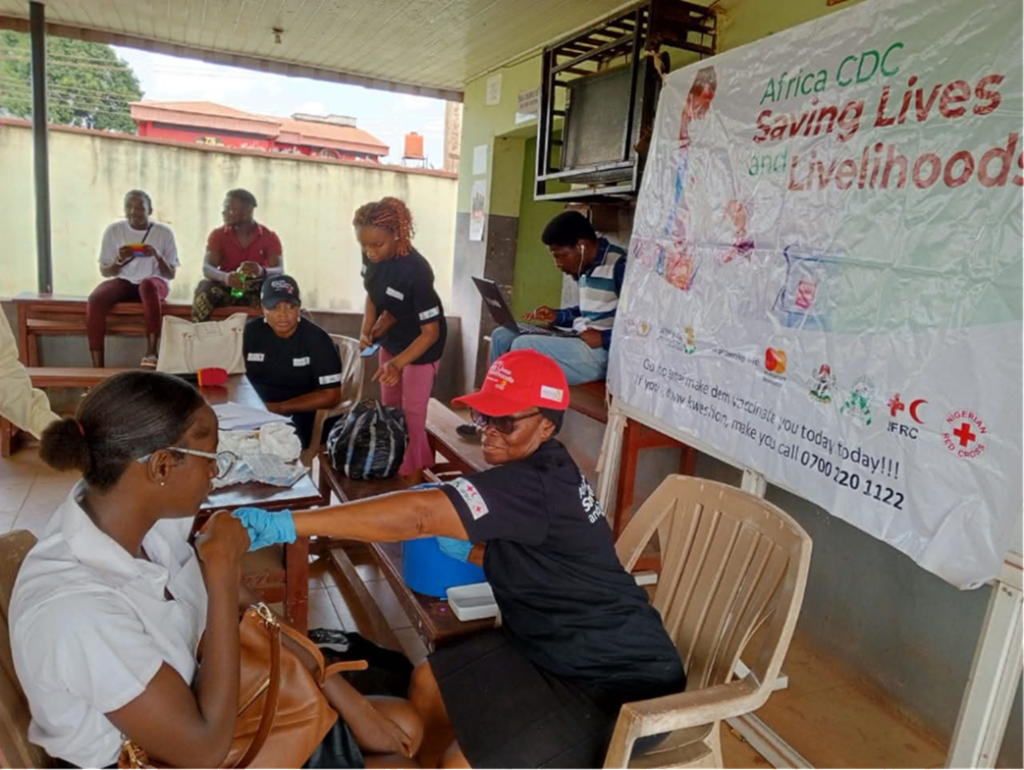
But in Karshi, the tide began to turn when the NRCS stepped in. The organisation’s efforts were part of a broader continental push supported by the Africa Centres for Disease Control and Prevention and the Saving Lives and Livelihoods (SLL) initiative — a historic $1.5 billion partnership with the Mastercard Foundation.
The three-year project, launched in June 2021, is the largest public health partnership between a global philanthropic organisation and an African institution. It built on the work of the African Vaccine Acquisition Trust, the COVID-19 Vaccines Global Access initiative, the World Health Organisation, and African governments to provide safe vaccines to the continent’s population.
Breaking resistance
In the second phase of the project, the partnership expanded its scope and scale, focusing on completing the vaccination of healthcare workers and vulnerable groups, building a robust workforce of community health workers, among others. Across Africa, SLL invested in vaccine procurement, last-mile delivery, risk communication, and strengthening health systems to ensure vaccines didn’t just arrive in warehouses but reached arms in communities like Karshi.
Instead of imposing solutions, Red Cross volunteers met with the district head and religious leaders, patiently explaining the purpose of the vaccine. Religious and traditional leaders became the first to be vaccinated, publicly displaying their vaccine cards. That visible act of trust, reinforced by house-to-house sensitisation drives, helped dismantle fears and rebuild confidence.
“Even now, the district head still carries his vaccine card. That made people believe the vaccine was safe,” Hamza said with pride.
The NRCS did not stop at the palace and religious gates. Together with local volunteers, they went door to door, listening to fears, answering questions, and countering myths.
“We gathered men and women in the Emir’s palace. We told them the importance of the vaccine. Then we went area by area, house by house, telling people.
“Before, our people were afraid. But once they started taking it, they saw the impact. That time, people were affected by cough and other things. So, they took the vaccine, and they also adopted other measures like covering their nose, putting on face masks, washing their hands. They realised it was protecting them,” he stated.
It was a slow process, but trust began to take root. Seeing familiar faces, community health aides, respected leaders, and neighbours who had taken the vaccine reassured hesitant families.
“People developed confidence in the vaccine when we cleared their doubts, explained the details and possible side effects,” Hamza added.
Shifting attitudes
The change extended beyond COVID-19. After experiencing the benefits of COVID-19 vaccines firsthand, attitudes shifted.
“Because of the impact of the vaccine they took during COVID-19, many people now are taking their children for immunisation. If you go to our primary health centre, you will see it in the record,” he said.
The newfound confidence in vaccines has not only strengthened trust within Karshi but also inspired neighbouring communities. Routine immunizations for children, including polio, measles, rubella, and Human papillomavirus are now being embraced more widely.
The Youth Leader of the Karshi Forum, Abubakar Yamanashara also credited much of the success to the active support of traditional leaders, who continued to encourage residents to take vaccines even after the COVID-19 campaign ended.
“Because of what people saw here in Karshi, how people’s health improved and how freely they now take their vaccines, other communities began to take notice. Health-seeking behaviour has really improved. People are even enrolling more in the National Health Insurance Scheme because they now trust the health system.
“Now, people from nearby places like Lika and Orida come all the way here to get vaccinated and seek medical attention.
“We even have an outpost for health education now. Mothers are bringing their children to the health centre for routine immunisation more than before. They take their children for the rubella, HPV, polio, and other vaccines without fear,” Yamanashara stated.
For the Red Cross, sustaining that trust remains a priority. The Branch Communications Coordinator and Information Management Focal Person for NRCS, Roseline Eke Emele, said the trust Karshi residents now have in vaccines is rooted in years of Red Cross presence in the community.
“So, for Karshi as a community, Red Cross had already been carrying out Risk Communication and Community Engagement activities before the COVID-19 vaccination drive started.
“It was based on that trust, on the previous activities that were done, that made the community say, ‘We’ve known Red Cross for long. If they are encouraging us to take the vaccine, it is not something that will bring negativity to us.’ So, they were open to it,” she explained.
To sustain the momentum, she said the NRCS keeps engaging communities, not just around vaccines but in broader health and social areas.
“We have what we call Mother’s Clubs, where women in the community learn different things about how to keep their family, how to maintain good hygiene, and how to meet health needs.
“That relationship that’s been established between Red Cross and Karshi is still in existence regardless of what may come,” Emele said.
She noted that the resilience built during the COVID-19 period has changed how communities respond to health emergencies.
“After the vaccine intake, they were resilient when it comes to outbreaks or viruses. So now, it is not strictly about COVID-19 vaccination, but sustaining that same community engagement,” she added.
The Karshi experience mirrors broader national trends. A 2024 study, published in Science Direct, found that although misinformation and distrust slowed vaccine uptake during the pandemic, Nigerians are now showing renewed confidence in vaccines. The study led by Victor Femi-Lawal of the Department of Medicine and Surgery, Faculty of Clinical Sciences, College of Medicine, University of Ibadan, Ibadan, Oyo State, noted that vaccine coverage in Nigeria has been steadily improving, with post-COVID surveys indicating a rebound in public trust and more positive perceptions toward vaccination.
Education, access to reliable information, and visible community engagement were identified as the strongest drivers of uptake, the same principles the Red Cross applied in Karshi.
The authors also observed that social media misinformation and low trust in government institutions remained key barriers, reinforcing the need for community-level dialogue and trusted intermediaries such as local leaders and volunteers.
“An approach that harnesses community involvement has typically helped improve vaccination outcomes. Community education is a well-documented intervention method, and it is important to inform members of the community about the significant benefits of vaccines and allay existing fears, particularly through engagement with opinion leaders and engagement with community stakeholders.
“Studies in various communities within and outside Nigeria have shown that positive views about vaccination within a person’s community helped promote vaccine uptake. In contrast, negative opinions about vaccination caused the uptake of vaccines within the community to decrease significantly,” the authors said.
Strengthening health systems
Emele also highlighted the organisation’s role in bolstering Nigeria’s health system at the grassroots. She added that NRCS ensures inclusivity by bringing in community representatives.
“What we do in Red Cross most of the time is, if there is any activity, we tend to train different people and we have what we call stakeholders’ engagement.
“Most people in the primary health care and public health space are engaged, either to keep them informed of recent happenings or to build their capacity through training.”
“We invite those in the community as well from their different groups. That way, they are part of the process, and it strengthens the link between community structures and formal health systems,” she said.
Beyond Karshi
For Karshi residents, the story is no longer one of hesitancy but of confidence. More people are vaccinated, childhood immunisation rates are climbing, and trust in health interventions has grown stronger.
The shift shows that when communities are engaged with empathy, dialogue, and respect, lives can be saved.
According to the Director General of the Africa CDC, Dr. Jean Kaseya, the “Saving Lives and Livelihoods initiative with the Mastercard Foundation has shown the power of respectful and action-oriented partnerships rooted in collaboration, coordination and systems strengthening.
“The experience and learnings from Phase I will enable us to move with greater speed and scale to deliver with accelerated impact to our member states,” he added.