Kinshasa, Democratic Republic of the Congo, 6 August 2026
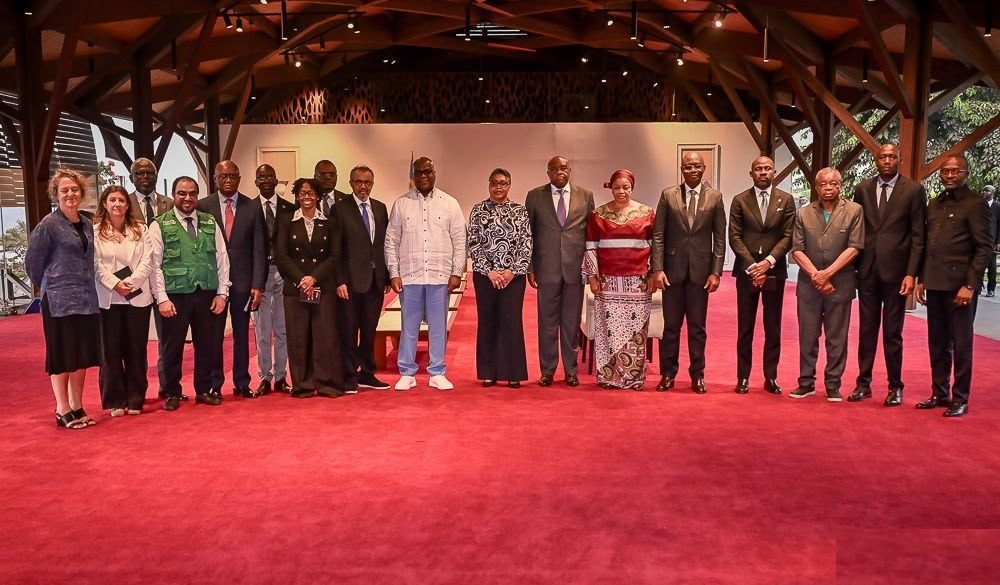
The Africa Centres for Disease Control and Prevention (Africa CDC) welcomes the outcomes of the high-level crisis meeting convened on 5 August 2026 at the Cité de l’Union Africaine in Kinshasa by H.E. Félix-Antoine Tshisekedi Tshilombo, President of the Democratic Republic of the Congo, to accelerate efforts to bring the ongoing Ebola Bundibugyo outbreak under control.
The meeting brought together H.E. Prime Minister Judith Suminwa Tuluka and members of the Government involved in the response; H.E. Dr Jean Kaseya, Director-General of Africa CDC, Dr Tedros Adhanom Ghebreyesus, Director-General of the World Health Organization; Professor Mohamed Yakub Janabi, WHO Regional Director for Africa; and other senior officials and key partners.
The meeting concluded a joint high-level mission that began in Uganda and continued in Bunia, Ituri Province. In Uganda, Africa CDC and WHO congratulated the Government on successfully interrupting local Ebola transmission and examined the lessons arising from Uganda’s decisive leadership, rapid detection and response, strong preparedness systems, community engagement and cross-border cooperation. The delegation emphasized, however, that continued vigilance remains essential for as long as transmission persists in the DRC.
In Bunia, the delegation met the Governor of Ituri and his team, the National Ebola Response Coordination, community and religious leaders, representatives of affected communities, health workers, and national and international partners supporting the response. These consultations provided an opportunity to listen directly and respectfully to communities, assess operational challenges and identify the changes required to regain their trust and interrupt transmission.
The findings from the field were presented during nearly three hours of detailed discussions with President Tshisekedi. The participants acknowledged the exceptional gravity of the situation and recognized that many infections are occurring within communities, including during funerals and unsafe burials. Delayed detection, weaknesses in contact tracing and infection prevention and control, insecurity, population displacement, disrupted essential services and inadequate support for frontline personnel continue to sustain transmission.
Africa CDC and WHO commended President Tshisekedi for his personal leadership, his close monitoring of the outbreak and the clear guidance he provided for a fundamental shift in the response. They also recognized the strategic support of Prime Minister Suminwa Tuluka, the Government, provincial authorities and all national institutions involved in the response.
Based on the President’s guidance and the findings of the field mission, the meeting agreed on eight immediate priorities that will guide the new 6-month response plan under preparation:
1. Establish a village-centered response
The response will move decisively toward a village-centered and community-led model. Traditional and religious leaders, women’s and youth organizations, community health workers, survivors and other trusted local actors will be empowered to co-lead prevention, early alerts, contact identification and follow-up, rapid referral of suspected cases, risk communication, and safe and dignified burials.
Operational, financial and logistical support must reach communities directly. Communities should have the information, tools and trusted support required to protect themselves, report suspected cases early and ensure that patients receive safe care in appropriate health facilities rather than remaining or dying at home.
2. Implement free healthcare and stabilize the health workforce
Africa CDC and WHO will support the Government’s decision to provide free access to health services for the populations of Ituri and North Kivu. This support will cover public, faith-based and private health facilities participating in the initiative and will include essential medicines, protective equipment, supplies and adequate operational financing. Particular attention will be given to the timely, transparent and equitable payment of salaries, risk allowances and other entitlements for health and care workers and response personnel. No response can succeed while frontline workers remain unpaid, inadequately protected or compelled to interrupt essential services.
3. Accelerate the digital transformation of the response
A strong digital agenda will be established to connect community alerts, epidemiological surveillance, laboratory results, contact follow-up, clinical care, logistics and financial monitoring through an interoperable, real-time national platform. This will improve the speed and quality of reporting, shorten the time between an alert and an operational response, support evidence-based decisions and strengthen national ownership of health data. The Ebola response should also accelerate the development of the DRC’s broader national digital health infrastructure.
4. Safeguard the reopening of schools in September
The Government and its partners will work to ensure that the school year can begin as planned in September, with appropriate measures to protect children, teachers, school personnel and families. This will require clear infection-prevention protocols, training for teachers and school administrators, access to hygiene facilities, age-appropriate risk communication, rapid alert and referral mechanisms and practical contingency plans for schools in affected areas.
5. Accelerate the Research and Development of Vaccines and Therapeutics
In the absence of a vaccine specifically licensed against Bundibugyo virus, it was agreed to accelerate the evaluation of candidate vaccines. Available data suggest that Ervebo, which is licensed against Zaire ebolavirus, may induce a cross-reactive immune response. Its use will therefore be conducted within approved research protocols and in accordance with applicable scientific, ethical and regulatory standards.
The evaluation of remdesivir, administered alone or in combination with the monoclonal antibody MBP134, will also be accelerated among patients with confirmed infection. Its use will continue to be scaled up across the affected areas.
6. Develop an integrated health and humanitarian plan
A tailored humanitarian plan will be developed alongside the Ebola response plan. Conflict, insecurity, displacement, food insecurity, inadequate water and sanitation, limited access to healthcare and population movements are not parallel challenges—they are directly contributing to the spread of the outbreak. The integrated plan will address the health, food, water, sanitation, shelter, protection and access needs of affected communities while supporting humanitarian access and the continuity of essential public services.
7. Intensify cross-border cooperation
Cross-border surveillance, laboratory collaboration, real-time information exchange, joint investigation of alerts and preparedness will be reinforced between the DRC, Uganda, South Sudan, the Republic of Congo and other neighboring and at-risk countries. Recent collaboration between the DRC and Uganda—including strengthened surveillance and the deployment of diagnostic capacity closer to border communities—demonstrates the importance of coordinated regional action. Ebola does not respect national borders, and the response must therefore combine strong national leadership with sustained regional solidarity.
8. Strengthen coordination, transparency and accountability
The Government-led coordination mechanism will be reinforced around one response plan, one operational framework, one budget and one monitoring and accountability system.
All funding, irrespective of the channel through which it is provided, should be mapped and transparently tracked from the donor to the province, health facility, village and beneficiary. Implementing institutions will be expected to demonstrate results, eliminate duplication and ensure that resources rapidly reach communities and frontline teams. According to figures presented during the discussions, international partners had already mobilized more than US$420 million for the response.
Africa CDC also welcomes the announcement made the same day by the United States on 5 August of an additional US$242 million for immediate Ebola response, regional preparedness and outbreak-related humanitarian assistance. This support is distinct from the US$350 million allocation for broader humanitarian assistance in the DRC, South Sudan and Uganda.
These substantial commitments must now translate into faster detection, safer care, protected and properly supported health workers, strengthened communities and a measurable reduction in transmission.
Implementation of these decisions will begin immediately. The Government of the Democratic Republic of the Congo, Africa CDC, WHO and partners will translate the agreed priorities into a time-bound and costed operational plan, with clearly identified responsibilities, milestones and indicators.
A further high-level meeting will be convened in October 2026 under the leadership of President Tshisekedi, with Dr Tedros, Dr Kaseya and key national and international partners, to evaluate progress after two months of intensified implementation, address remaining obstacles and take any additional decisions required to end the outbreak.
“The guidance provided by President Tshisekedi marks a decisive shift. Success will now be measured village by village: communities leading the response, alerts investigated rapidly, patients referred safely, health workers protected and paid, children returning to school safely, and every available dollar reaching the people for whom it was intended,” said Dr Jean Kaseya, Director-General of Africa CDC.
Africa CDC expresses its deepest solidarity with the people of the Democratic Republic of the Congo and conveys its condolences to all families who have lost loved ones. It salutes the courage and dedication of health and care workers, community health workers, burial teams, laboratory personnel, local authorities, community leaders, humanitarian workers and partners who continue to serve under exceptionally difficult circumstances.
Under the leadership of the Government of the Democratic Republic of the Congo, and with communities at the centre of the response, Africa CDC and WHO reaffirm their determination to work alongside all partners until transmission is interrupted and the outbreak is brought to an end.
###
About Africa CDC
The Africa Centres for Disease Control and Prevention is the public health agency of the African Union. As an autonomous institution, Africa CDC supports AU Member States in strengthening health systems, improving disease surveillance, and enhancing emergency preparedness and response. For more information, visit: http://www.africacdc.org and follow Africa CDC on LinkedIn, X, Facebook, and YouTube.
Media enquiries
Africa Centres for Disease Control and Prevention | Email: communications@africacdc.org
.