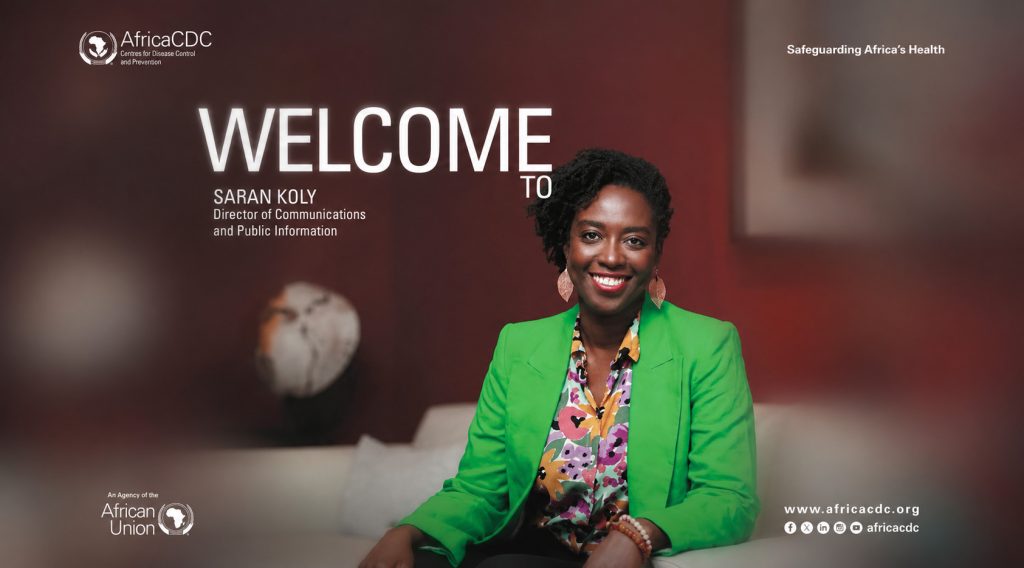
Saran Koly has been at the helm of boardrooms, strategising communications, driving public health advocacy, shaping media relations, handling crisis communications, taking charge of institutional positioning, and telling stories across Africa, and globally for more than two decades. Towards the end of May, she brought this expertise to Ethiopia. Precisely to Africa Centres for Disease Control and Prevention (Africa CDC) in Addis Ababa.
What lies before her is transforming communications at the 10-year-old Africa CDC which straddles across more than six main technical divisions: Surveillance and Disease Intelligence, Emergency Preparedness and Response, Laboratory Systems and Networks, Public Health Institutes and Research, Public Health Information Systems, Infectious Diseases, along with five Regional Collaborating Centres. These divisions are the interface of public health work that occurs in 54 Africa Union member states, which calls for Saran’s extensive knowledge.
Saran joins Africa CDC at a time when a rare Bundibugyo virus disease (BVD) is causing a headache in the Democratic Republic of Congo (DRC) and neighbouring Uganda.
“I am used to being thrown into the deep end. In many ways, that has shaped my career. This role, however, carries a particular responsibility because Africa CDC’s work touches people’s lives directly, especially in moments of fear, uncertainty and crisis,” said Saran.
Her mandate is to help transform the way the institution communicates with more speed, more clarity, more humanity and a stronger digital instinct. “Public health communication has to speak to people, not only to systems. Behind every number, every situation report and every high-level meeting, there are families, health workers, communities and responders doing difficult work under pressure. Their stories matter,” she said.
Regular multiple emergencies and outbreaks hitting Africa, including cholera, measles, yellow fever, meningitis, marburg and mpox act as a fertile ground for communications as Africa CDC and partners work together in responses. Saran is banking on Africa CDC’s extraordinary talent across the institution to deliver. “I hope to contribute to making that talent, that work and that impact more visible across Africa and globally,” she said.
Before joining Africa CDC, Saran held Director-level communications roles with Africa50, Equal Measures 2030 and UNICEF, alongside senior communications, advocacy and crisis response roles with WHO, the United Nations High Commissioner for Refugees, United Nations Development Programme, Transparency International and other international organisations.
Her work spans public health, emergency response, humanitarian crises, gender equality, governance, infrastructure, advocacy campaigns, media engagement and institutional positioning.
The abundance of talent at Africa CDC will see the share of humanitarian money, donations from African governments, philanthropists, and international partners being put to good use.
“Africa CDC is full of talented people doing serious work across the continent. My priority is to help bring that work to the forefront with more clarity, more rhythm and more confidence,” she said. “We need to communicate faster, coordinate better and show up with a stronger voice across platforms, countries and audiences. That means making our technical work is easier to understand, making our impact more visible, and building trust with the people we serve,” Saran added.
Africa CDC is doing work that matters. Its communications should make that work visible, understandable and felt.
“We have no shortage of important work to communicate. The real task is to give it shape, rhythm and reach, so people can understand what Africa CDC does, why it matters, and how it connects to their lives,” she said.
Saran is bilingual in French and English, with fluency in Spanish and Portuguese, and brings a strong pan-African perspective, deep multicultural experience and a commitment to clear, strategic and impactful communications.
“We have to innovatively use appropriate and suitable channels that meet the demands of the day, with speed and accuracy that advances conversations, enriches understanding and bring spotlight on health issues,” Saran said noting the vastness of divisions and Africa CDC workforce which carries out work on the ground. “Otherwise, we won’t achieve much, or we remain standing on the same spot.”
Dr Jean Kaseya, Africa CDC Director General, said, Saran joins Africa CDC at an important moment for the institution and for public health on the continent.
“As Africa faces multiple and complex health threats, clear and trusted communication is central to our mandate. Saran brings strong strategic communications experience and editorial judgment with a pan-African perspective. Her leadership will help strengthen Africa CDC’s voice, visibility and public trust across Africa and globally,” Dr Kaseya said.