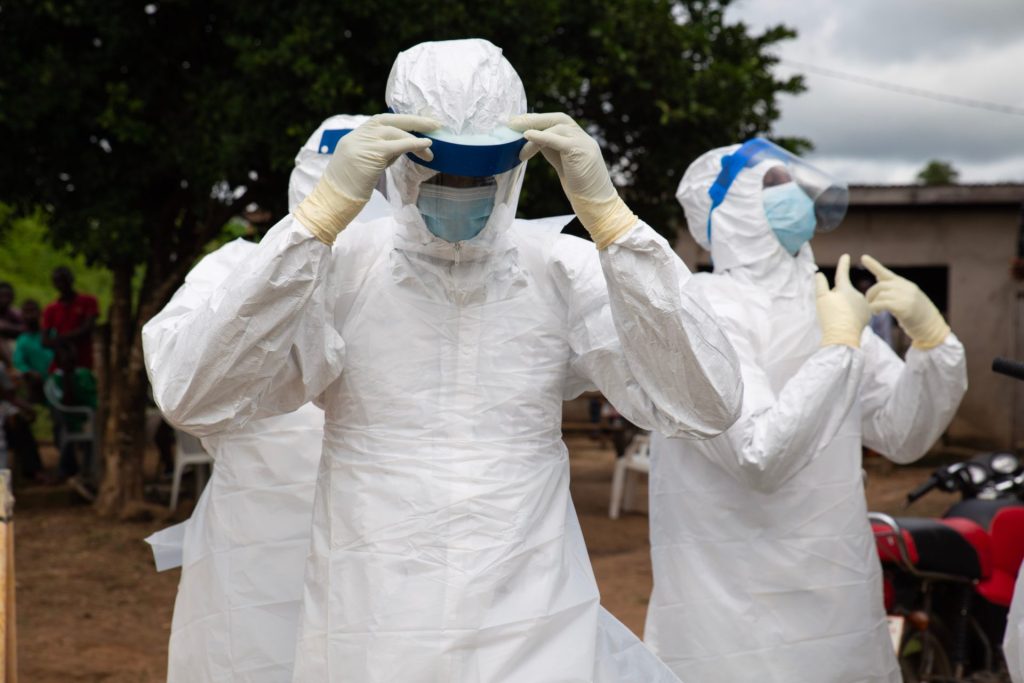
Addis Ababa, 17 August 2026 – Three months after the declaration of the Ebola outbreak caused by Bundibugyo virus in the DRC, the evolution of this epidemic has exceeded our gravest expectations.
Africa CDC commends Uganda for successfully ending its outbreak on 28 July 2026. Uganda’s achievement demonstrates that Bundibugyo Ebola can be contained when proven public health measures are implemented rapidly, comprehensively and with communities at the Centre.
At the same time, Africa CDC observes with deep concern the continued deterioration of the situation in DRC, where insecurity, displacement, humanitarian pressures, disruptions to essential health services, delayed detection and persistent gaps in community trust continue to sustain transmission. This outbreak has demonstrated an extraordinary speed of transmission, a devastating capacity to take lives and an unprecedented geographic expansion. The DRC has confronted Ebola 17 times, yet never before has the country experienced an Ebola outbreak expanding at this speed and on this scale.
In only twelve weeks, the current outbreak has already surpassed both the total number of cases and deaths recorded during the 2018–2020 Ebola outbreak in eastern DRC, which lasted almost two years.
From 8 confirmed cases, concentrated in three health zones of one province (Ituri) on 15 may 2026, as of 17 August 2026, the DRC had reported more than 5,000 confirmed cases and more than 2,320 deaths across six provinces: Ituri, North Kivu, South Kivu, Haut-Uele, Bas-Uele and Tshopo.
The current outbreak is already the deadliest Ebola outbreak in the history of the DRC, the fastest-growing Ebola outbreak on record. With a case fatality ratio approaching 50%, it is now taking approximately one life every 30 minutes. Unless its trajectory is urgently reversed, it risks becoming the deadliest Ebola outbreak ever recorded globally. The world cannot wait for that projection to become reality.
“Behind every number is a person, a family and a community living with fear and loss. These deaths are not inevitable. We call for a humanitarian ceasefire and safe, sustained access for health workers, humanitarian responders and essential supplies. We call on governments to lift blanket travel and trade restrictions that are not grounded in science. Such measures push people and goods through unmonitored crossings, disrupt supply chains and make containment more difficult. This crisis is also a stark reminder that Africa must accelerate the local manufacturing of diagnostics, therapeutics, vaccines and other essential health commodities.”
— H.E. Cyril Ramaphosa, President of South Africa, Chairperson of SADC and African Union Champion for Pandemic Prevention, Preparedness and Response, Durban, 17 August 2026
THE TIME FOR HESITATION IS OVER
At this stage of the epidemic, delays have consequences measured in human lives. This is no longer the time for hesitation, fragmented approaches, competing strategies or unacceptable prolonged institutional processes. The epidemiological trajectory demands urgency, unity of purpose and implementation at scale.
Africa CDC therefore calls for the immediate and full implementation of the six mutually reinforcing interventions endorsed under the leadership of H.E. President Félix-Antoine Tshisekedi during the high-level meeting of 5 August 2026:
- A village-centered, digitally transformed response led by trusted community health workers..
- Protocol-governed expanded use of the ERVEBO vaccine.
- Free access to essential health services and a reliably paid, protected and equipped health workforce.
- Treatment and post-exposure prophylaxis under approved protocols.
- Integrated management of humanitarian needs, including the safe reopening of schools.
- Strong coordination and end-to-end financial accountability.
These six interventions must now move from political decisions to full-scale operational implementation, with leadership, measurable targets, adequate financing and accountability for results.
AFRICA CDC SUPPORTS THE DRC’S REQUEST TO THE ICG
Following the deliberations of the independent Emergency Consultative Group (ECG)—comprising leading public health and scientific experts from across Africa—at its meeting of 13 August 2026, Africa CDC endorses the ECG’s recommendations and supports the submission made by DRC to the International Coordinating Group (ICG) on Vaccine Provision concerning access to the ERVEBO vaccine.
Africa CDC recognises that ERVEBO is a licensed vaccine for Zaire Ebola and the available evidence of cross-protection remains limited and does not yet establish clinical effectiveness. At the same time, the extraordinary scale, speed and mortality of this emergency require that every scientifically, ethically and legally responsible option capable of protecting communities and saving lives be considered with urgency.
Africa CDC therefore supports a scientifically rigorous, protocol-governed approach combining carefully controlled expanded use to ERVEBO frontline workers at great risk with a Phase III clinical trial designed to generate robust evidence on the vaccine’s safety and effectiveness against Bundibugyo virus. Any such use must remain subject to the appropriate national regulatory, ethical and scientific authorizations, and informed community participation.
Vaccination will reinforce—not replace—the full package of proven outbreak-control measures, including rapid diagnostics and isolation, contact follow-up, safe and dignified burials, infection prevention and control under the leadership of trusted community health workers.
Community acceptance, early care-seeking, and adherence to public health measures remain essential to interrupting transmission. Equally fundamental are ensuring adequate infection prevention and control (IPC) measures for frontline health workers and providing timely, high-quality clinical care for people affected by BVD.
At the current reported pace of mortality, everyday avoidable delay means around 50 lives lost. Africa CDC therefore calls on the ICG, and all institutions involved to review and decide on the DRC’s submission with the exceptional urgency demanded by this public health emergency.
This is not a call to lower scientific, regulatory or ethical standards. It is a call to apply those standards with the speed, responsibility and urgency required by an epidemic that is taking lives every few minutes.
ONE GOVERNMENT, ONE RESPONSE, ONE DIRECTION
Africa CDC calls on all partners to align fully behind the leadership of the Government of DRC. There can be no competing strategies, fragmented implementation, institutional rivalry or parallel systems in an emergency of this magnitude. Political leadership, scientific evidence, operational capacity, humanitarian action and community ownership must converge into one coherent response capable of operating on a scale.
“When lives are being lost at this scale, our responsibility is neither to ignore uncertainty nor to be paralyzed by it. Our responsibility is to use the best available science, protect communities, generate the evidence that is still missing and act together. Africa CDC calls for the strongest possible alignment of all partners under the leadership of the Government of the DRC. We must put communities first and use every scientifically and ethically responsible option available to save lives. The time for hesitation is over. The time for decisive, coordinated and large-scale action is now.”
— H.E. Dr Jean Kaseya, Director General, Africa CDC
Africa CDC remains fully mobilized alongside the Government and people of DRC, WHO and all partners to interrupt transmission, protect affected communities, save lives and bring this epidemic under control.
Every life matters. Every day matters. Every delay matters.
###
About Africa CDC
The Africa Centres for Disease Control and Prevention is the public health agency of the African Union. As an autonomous institution, Africa CDC supports AU Member States in strengthening health systems, improving disease surveillance, and enhancing emergency preparedness and response. For more information, visit: http://www.africacdc.org and follow Africa CDC on LinkedIn, X, Facebook, and YouTube.
Media enquiries
Directorate of Communications and Public Information, Africa CDC | Email: communications@africacdc.org