
New York/Addis Ababa, 24 September 2026
Africa CDC welcomes the historic mobilisation achieved at the G20+ Foreign Ministers Meeting on Accelerating Collective Action to Defeat Ebola, convened by the United States on 23 September 2026 in New York on the margins of the United Nations General Assembly. The meeting demonstrated what can be achieved when political leadership, affected countries and international partners unite behind one objective: to stop transmission, save lives and end the outbreak.
What appeared difficult only weeks ago became possible yesterday. Commitments made since the outbreak was declared have now reached approximately US$2.9 billion, including around US$700 million announced in connection with the New York meeting. This unprecedented mobilization of cash and in-kind assistance must now be converted rapidly into disbursements, implementation and measurable results in affected communities.
Africa CDC salutes the leadership of the United States in convening the meeting and for its substantial contribution to the response, now totalling US$886 million. Africa CDC also recognises the major contributions from the European Union, World Bank, the Pandemic Fund, African countries, international financial institutions, bilateral partners, philanthropies and other partners that have stood with the affected countries.
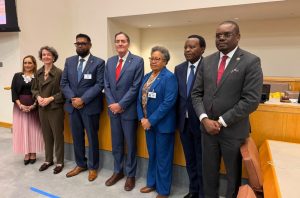
The meeting brought together the Governments of DRC and Uganda, G20 members, partner countries and international organisations. Africa CDC participated in its continental coordination role and as co-lead, with WHO, of the Incident Management Support Team, reinforcing a common message: financing must support continental cross border activities, nationally led priorities and reach the frontline quickly.
U.S. Under Secretary of State Allison Hooker underscored the need for collective action and sustained international burden-sharing to defeat Ebola, with resources rapidly translated into treatment, surveillance, contact tracing, protective equipment and other lifesaving interventions on the ground.
Prime Minister H.E. Judith Suminwa Tuluka reaffirmed the leadership and determination of the DRC, describing the outbreak as a “major test” for the country and stressing that “for the DRC, fighting this epidemic is an absolute priority.” Her intervention placed national ownership, protection of communities and rapid delivery at the centre of the international mobilisation.
Reflecting on Uganda’s experience in ending transmission, H.E. Adonia Ayebare, Minister of Foreign Affairs of Uganda, highlighted four factors that made the difference: strong political leadership, a health system that is prepared to respond, the trust and engagement of communities, and excellent cross-border cooperation with neighbours including the Democratic Republic of Congo.
Commissioner Hadja Lahbib has stressed that health threats do not stop at borders and that the response cannot either—an approach reflected in the European Union’s sustained cooperation with Africa CDC and WHO. The European Union has mobilized €500 million in emergency aid, vaccines, treatment and health security in the Great Lakes and Uganda region. This support spans immediate response, diagnostics, medical countermeasures, humanitarian assistance, research and longer-term health security.
Highlighting the scale of World Bank support, Mamta Murthi, Vice President for People at the World Bank, emphasised that more than US$433 million has been mobilised to support the Ebola response and preparedness in the DRC and across the region by working closely with Africa CDC and WHO, and that financing must translate rapidly into stronger health systems, trusted community action and results on the ground.
FROM PLEDGES TO RESULTS: TRANSPARENCY AND TRACEABILITY
Africa CDC emphasises that the success of the New York meeting will ultimately be measured not by the headline amount pledged, but by how rapidly resources are disbursed, where they are deployed, what gaps they fill and what they deliver for affected communities.
“Yesterday demonstrated what is possible when political leadership and international solidarity come together. We thank the US for this leadership and sense of solidarity by convening the 20 Ministerial meeting. But pledges alone will not stop Ebola. We must be able to trace every single dollar—from commitment to disbursement, from implementing partner to expenditure, and ultimately to the services delivered to affected communities. Transparency builds trust, accelerates delivery and saves lives.”
— H.E. Dr Jean Kaseya, Director General, Africa CDC
Africa CDC will therefore strengthen the Africa CDC Financial Tracking Mechanism and, working closely with the Government of the DRC, WHO and partners, ensure greater visibility over commitments, disbursements, expenditures, implementation locations and results. The objective is not to create another reporting layer, but to give the Government a consolidated view of the resources supporting its national response and enable faster, evidence-based decisions.
The Government of the DRC must be able to see where resources are going, who is implementing them, what gaps remain and what results are being achieved. Greater transparency will strengthen national leadership, reduce duplication, identify underfunded priorities and help move resources quickly to the health zones, villages and communities where they can have the greatest impact.
DELIVERY MUST NOW ACCELERATE
The New York mobilisation must now translate into faster delivery on the ground: support for frontline health workers; stronger surveillance and laboratory capacity; rapid diagnosis and treatment; contact tracing; infection prevention and control; safe and dignified burials; risk communication and community engagement; access to medical countermeasures; and sustained preparedness in neighbouring countries.
Africa CDC will continue to promote a community- and village-centred response that rebuilds trust and places affected populations at the heart of decisions. In an outbreak sustained by mobility, insecurity and cross-border movement, public health action must also remain closely connected with humanitarian assistance and regional preparedness.
Africa CDC thanks the United States, the Governments of the Democratic Republic of the Congo and Uganda, G20 members, the World Bank, the Pandemic Fund, the European Union, WHO and all partners for their renewed commitment. The mobilisation achieved in New York is a major demonstration of solidarity; it must now become a demonstration of delivery.
US$2.7 billion mobilised carries a clear responsibility: turn every commitment into action, every disbursement into measurable results, and global solidarity into the end of the Ebola outbreak.
ENDS
| Updated estimates of Pledges to the Ebola response | |
| Following G20+ Eobla Pledging event hosted by the U.S. on 23 September | |
| Funder | As of 23 Sep, USD million |
| United States | 887 |
| EU / European Commission | 568 |
| World Bank | 433 |
| Pandemic Fund | 221 |
| CEPI | 196 |
| Germany | 127 |
| African Countries | 110 |
| United Kingdom | 105 |
| CERF | 90 |
| Gavi | 45 |
| Mastercard Foundation | 20 |
| Gates Foundation | 18 |
| China | 18 |
| Republic of Korea | 18 |
| Global Fund | 17 |
| Sweden | 17 |
| France | 16 |
| Wellcome Trust | 14.5 |
| AfDB | 13 |
| Japan | 12.4 |
| United Arab Emirates | 10 |
| Netherlands | 8 |
| Australia | 7 |
| Denmark | 4.7 |
| Switzerland | 4 |
| Belgium | 4 |
| Norway | 3.8 |
| NovoNordisk Foundation | 2 |
| Singapore | 2 |
| Canada | 2 |
| Unitaid | 1.3 |
| Spain | 0.8 |
| The Rockefeller Foundation | 0.4 |
| CIFF | 0.3 |
| Italy | 0.3 |
| Ireland | 0.2 |
| Iceland | 0.15 |
| Greece | 0.1 |
| Cyprus | 0.09 |
| Thailand | 0.03 |
| Total | 2.997 billion |
###
About Africa CDC
Africa CDC is the public health agency of the African Union. As an autonomous institution, Africa CDC supports AU Member States in strengthening health systems, improving disease surveillance, and enhancing emergency preparedness and response. For more information, visit: http://www.africacdc.org and follow Africa CDC on LinkedIn, X, Facebook, and YouTube.