
Two neighbours will strengthen joint preparedness and response to public health emergencies
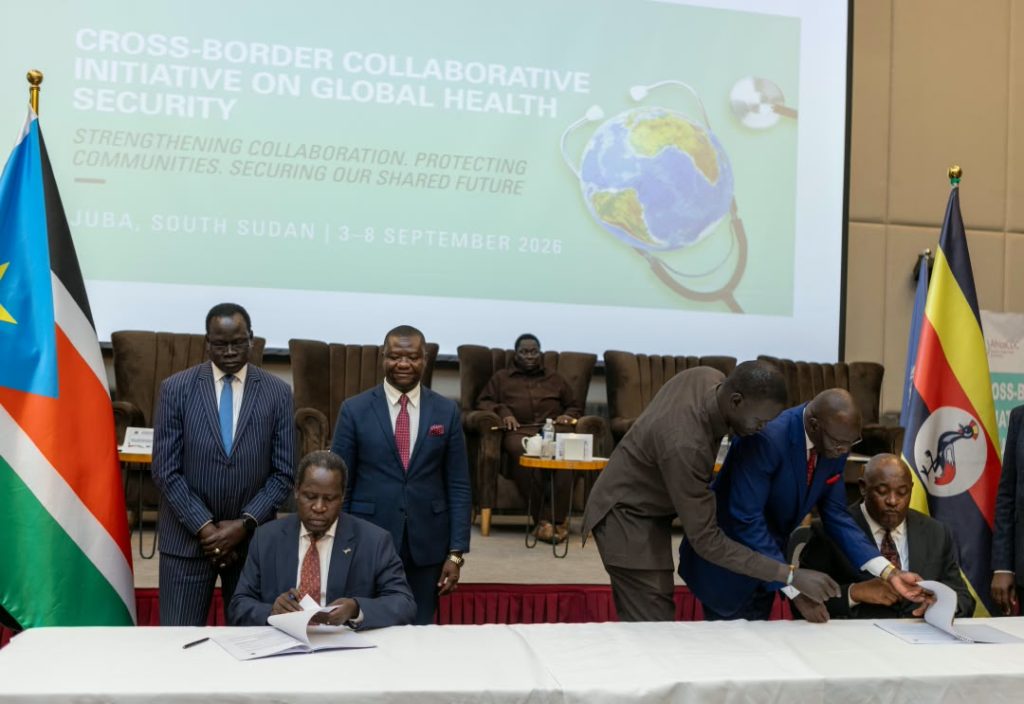
South Sudan, Juba, 10 September 2026 – With an active Ebola outbreak still raging across the region, Uganda and South Sudan have signed a Memorandum of Understanding to jointly detect, prevent and respond to public health emergencies along their shared border.
Signed on 7 September and facilitated by the Africa Centres for Disease Control and Prevention (Africa CDC), the UK Health Security Agency (UKHSA) and the World Health Organization (WHO) through the Continental Incident Management Support Team (IMST), the agreement gives both countries a shared operational framework against Bundibugyo Virus Disease, viral haemorrhagic fevers, cholera and other cross-border disease threats.
The Ministries of Health of the Republic of Uganda and the Republic of South Sudan signed a Memorandum of Understanding (MoU) to strengthen cross-border cooperation on preparedness, prevention, surveillance and joint response to public health emergencies on 7 September.
Facilitated by the Africa Centres for Disease Control and Prevention (Africa CDC), the UK Health Security Agency (UKHSA) and the World Health Organization (WHO) through the Continental Incident Management Support Team (IMST), the agreement provides a framework for protecting communities along the shared border from Bundibugyo Virus Disease, viral haemorrhagic fevers, cholera and other infectious disease threats.
Hon. Luke Thompson Thoan Teny, MP, Minister of Health of the Republic of South Sudan, said the agreement would strengthen practical cooperation between the two countries. “I reaffirm South Sudan commitment to seamless information sharing, joint preparedness and a coordinated response to health threats, protecting our communities and securing our shared future,” he said.
“This MoU should not be another protocol or MoU that is signed today and sits on a shelf tomorrow. We are deliberately trying to build something different: a model of cooperation that is adaptive, operational and accountable.” Hon. Dr Chris Baryomunsi, MP, Minister of Health of the Republic of Uganda, emphasized the need to translate the agreement into measurable action:
The MoU comes at a critical time for regional health security as the ongoing Bundibugyo Virus Disease outbreak highlights the importance of coordinated action across borders. Although South Sudan has not reported a confirmed case, porous borders, high population mobility and health-system vulnerabilities increase the risk of importation. The country is also managing concurrent outbreaks of mpox, cholera, measles and circulating vaccine-derived poliovirus.
The MoU establishes practical mechanisms for cross-border surveillance and early warning, laboratory preparedness and sample referral, screening at points of entry, infection prevention and control, case management, vaccination coordination, contact tracing, risk communication and community engagement, as well as the movement of response personnel and supplies.
The MoU was signed in the presence of H.E. Hussein Abdelbagi Akol, Vice President of the Republic of South Sudan and Chair for the Service Cluster, demonstrating strong political commitment to cross-border health security. The Vice President underscored the importance of a whole-of-government approach, stating: “Health security is national security.”
Capacity building will be a key component of implementation, including skills exchange, mentorship and joint simulation exercises to strengthen health workers, response teams and institutions at national and subnational levels. The two countries will also establish mechanisms for timely notification, information sharing and regular cross-border coordination.
“South Sudan and Uganda are showing what African health security and sovereignty agenda (AHSS) means in practice: countries coming together to build solutions, learn from one another and act before a health threat becomes a wider crisis,” said Dr Lul Riek, Senior Regional Representative, Africa CDC Eastern Africa RCC, adding the initiative demonstrates African health security and sovereignty in action.
The MoU will remain in force for an initial three years, providing a sustained platform for joint preparedness and coordinated response. The initiative reinforces a simple but critical principle: health threats cross borders, so preparedness and response must cross borders too.
###
About Africa CDC
The Africa Centres for Disease Control and Prevention is the public health agency of the African Union. As an autonomous institution, Africa CDC supports AU Member States in strengthening health systems, improving disease surveillance, and enhancing emergency preparedness and response. For more information, visit: http://www.africacdc.org and follow Africa CDC on LinkedIn, X, Facebook, and YouTube.
Media enquiries
Directorate of Communications and Public Information, Africa CDC | Email: communications@africacdc.org