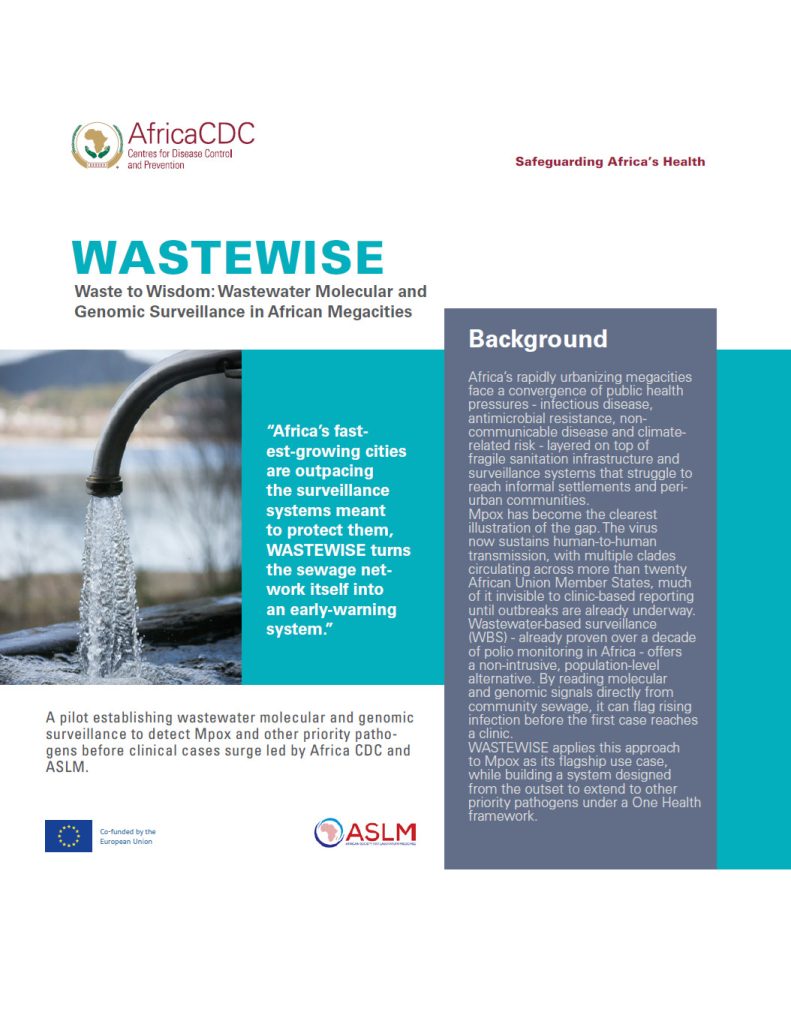
Africa’s rapidly urbanizing megacities face a convergence of public health pressures: infectious disease, antimicrobial resistance, non-communicable disease and climate-related risk, layered on top of fragile sanitation infrastructure and surveillance systems that struggle to reach informal settlements and peri-urban communities.
Mpox has become the clearest illustration of the gap. The virus now sustains human-to-human transmission, with multiple clades circulating across more than twenty African Union Member States, much of it invisible to clinic-based reporting until outbreaks are already underway.
Wastewater-based surveillance (WBS) — already proven over a decade of polio monitoring in Africa — offers a non-intrusive, population-level alternative. By reading molecular and genomic signals directly from community sewage, it can flag rising infection before the first case reaches a clinic.
WASTЕWISE applies this approach to Mpox as its flagship use case, while building a system designed from the outset to extend to other priority pathogens under a One Health framework.
.
“Africa’s fastest-growing cities are outpacing the surveillance systems meant to protect them, WASTЕWISE turns the sewage network itself into an early-warning system.”
A pilot establishing wastewater molecular and genomic surveillance to detect Mpox and other priority pathogens before clinical cases surge, led by Africa CDC and ASLM.