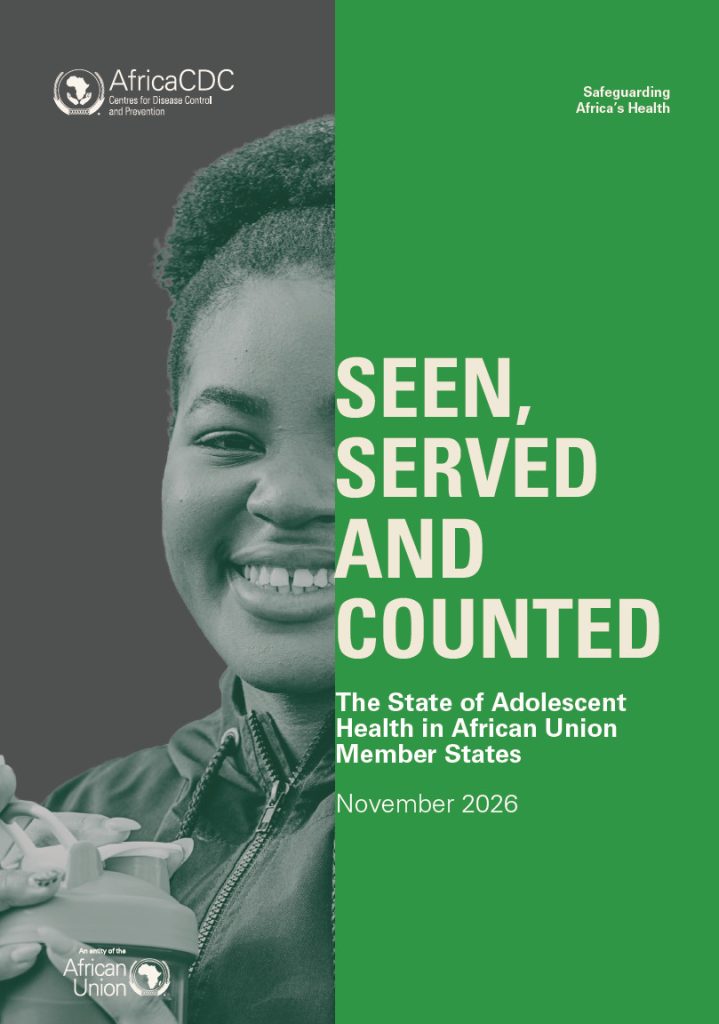
Adolescents aged 10-19 make up about one in four people in Africa, and early pregnancy, unsafe abortion, HIV and child marriage continue to shape their health and futures. The African Union’s Maputo Plan of Action, Agenda 2063 and Africa CDC’s maternal and child health agenda all commit Member States to improving adolescent sexual and reproductive health. This report draws on the Africa CDC continental assessment of the causes and drivers of maternal and child mortality to examine how far these commitments have been translated into policies, financing, services and outcomes for adolescents.
Ministries of Health in 55 AU Member States completed a structured questionnaire in 2026 covering SRH policy, financing, monitoring and annual service data for 2021-2025. Indicators relating directly or indirectly to adolescents were summarised as frequencies, percentages, pooled values and medians by region (Central, Eastern, Northern, Southern and Western Africa) and for Africa overall. Trends were described for 2021-2025, and relationships between adolescent services and teenage pregnancy were examined with Kendall’s tau. Implausible or inconsistent values were excluded and reported in each table.
Girls aged 10-19 make up 11% of the population in the 19 countries with usable data. Policy commitments to adolescent health are widespread but incomplete. Adolescent and youth SRH is included in the national SRH policies of 83% of responding countries (43 of 52), and comprehensive sexuality education in 60% of countries. However, 23% of countries (12 of 52) have no confidentiality provisions for adolescent services, most often in Northern Africa, and 29% (15 of 52) have no provisions on consent for adolescents. Services have not kept pace with policy: only 12.9% of health facilities provided adolescent- and youth-friendly services (AYFS) in 2025, with almost no change within countries since 2021, and in 12 of 15 countries (80%) fewer than half of facilities offered AYFS.
Teenage pregnancy remains high. Pregnancies among girls aged 10-19 accounted for 16.5% of all pregnancies (12 countries), ranging from 9.5% in Central Africa to 24.2% in Southern Africa, with only a slight decline from 17.9% in 2021. Health facilities recorded 132.9 pregnancies per 1,000 girls aged 15-19. Girls aged 10-14 accounted for 1.8% of adolescent pregnancies (1.9 per 1,000 girls), well below WHO’s estimate of 5.2% of adolescent births in sub-Saharan Africa, which suggests that pregnancies at this age, each of them a child protection concern, are largely unrecorded.
There were also signs of progress. Adolescent modern contraceptive use rose from 14.0 to 17.1 per 100 girls aged 15-19 between 2021 and 2025, with increases in 7 of 9 countries, and early postnatal care rose from a median of 57.0% of mothers to about 62%, with gains in 10 of 14 countries. None of the seven relationships tested between adolescent services and teenage pregnancy was significant after adjustment for multiple testing, although only 8-14 countries per pair the analysis could detect only strong associations.
Financing and data systems limit accountability. 58% of countries have a budget line for SRH, but 60% (21 of 35) do not track adolescent SRH spending separately, at a time when external health funding is falling. Indicators are not disaggregated by age in 37% of countries, and 25% do not monitor the adolescent birth rate. Population figures for eight countries appeared to include both sexes, and several indicators were reported by fewer than half of countries. The barriers countries reported most often were insufficient funding (73%), workforce constraints (71%) and limited data systems (63%).
Adolescent health is recognised in national policies across Africa, but the services, financing and data needed to turn these commitments into results are not yet in place in most countries. Adolescent-friendly services have not expanded, teenage pregnancy is declining only slowly, and pregnancies among very young adolescents remain largely hidden. Progress in contraceptive use and postnatal care shows that improvement is possible.
Seven actions are needed. First, adolescent-friendly service standards should be integrated into all primary health care facilities, with national targets and annual reporting. Second, consent and confidentiality barriers to adolescent SRH services should be removed, in line with the Maputo Plan of Action and the WHO 2025 guideline. Third, adolescent access to contraception should be expanded, including after pregnancy and delivery. Fourth, every pregnancy among girls aged 10-14 should be treated as a child protection case, with action on child marriage and on keeping girls in school. Fifth, adolescent SRH spending should be tracked in national budgets and National Health Accounts. Sixth, routine data should be disaggregated by age (10-14 and 15-19) and sex, and the adolescent birth rate should be monitored. Finally, the continental assessment should be repeated with standard indicator definitions and validation of country data.