Executive summary
This report examines the Bundibugyo virus disease outbreak and the continental response from the declaration on 15 May 2026 to the evidence available for preparation of the six-month milestone on 15 November. It integrates pathogen and transmission knowledge, zoonotic origin and One Health, epidemiology, clinical care, operational performance, country experiences, research, financing, logistics, essential health services, social consequences and preparedness.
The principal finding is that substantial response capacity was mobilized, but persistent transmission and mortality indicate that this capacity did not consistently translate into sufficiently early detection, timely access to care, complete identification of transmission networks and reliable local service delivery in DRC. The introduction that began the outbreak also remains unexplained, so the risk of further spillover in the affected landscape persists independently of progress against human-to-human transmission.
Key findings that should guide the next phase
1. The burden remains overwhelmingly concentrated in the DRC. Uganda, Kenya and Nigeria provide distinct experiences of managing cross-border or travel-associated infection. Their outcomes should be assessed against their own case histories and observation periods. France’s imported case and medical evacuations to other countries belong in a separate international account so that the same patient is not counted twice.
2. Early growth was exceptional, but historical comparison requires matched definitions. The early reported burden substantially exceeded burden observed during the comparable early periods of major 2014 and 2018 Ebola epidemics, although direct quantitative comparison is constrained by differences in case categories included, uncertainties in disease onset and official detection and declaration, ascertainment and observation intervals. Historical comparisons should therefore preserve the original case classifications and reporting periods.
3. Contact tracing misses most new cases: Only 11% of confirmed cases (1,146 of 10,659 with onset from week 19 to week 45) came from the contact lists, against a target of 95%. The response found the other 89% outside those lists, which means many transmission links were identified too late to list and monitor the contacts. The daily contact follow-up [text continues beyond the visible page].
Five headline numbers in the analytical snapshot
By 8 November 2026, five countries had reported 11,021 confirmed cases and 5,358 deaths, a crude case-fatality ratio (CFR) of 48.6%.
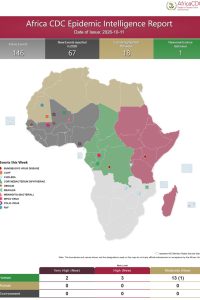
The DRC carries almost all of this burden, with 10,990 cases and 5,354 deaths (CFR 48.7%). Uganda reported 20 cases and 2 deaths, Kenya 9 and 2, Nigeria 1 imported case and no deaths, and France 1 imported case and no deaths.
In the DRC, 67 health zones in eight provinces have reported at least one confirmed case, and 51 of 67 health zones reported a case in the last 21 days.
National notifications have held at about 460 to 480 confirmed cases a week since late September; the epidemic is a sustained plateau and not yet declining.