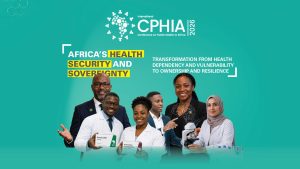

In late November 2026, Addis Ababa will host the 5th International Conference on Public Health in Africa (CPHIA 2026), co-convened by the Africa Centres for Disease Control and Prevention (Africa CDC) and the Government of Ethiopia. Its theme, ‘Africa’s Health Security and Sovereignty: Transformation from health dependency and vulnerability to ownership and resilience’, states its intent.
It is also a response to a financing and epidemiological reality that no longer allows business as usual. The numbers are stark. External health aid to Africa was projected to fall by about 70% between 2021 and 2025, while African countries were expected to spend $81 billion United States dollars (USD) (on debt service in 2025 alone).
Twenty-four years after the Abuja Declaration, only three countries, Botswana, Cabo Verde and Rwanda, have achieved the agreed target of 15% of national budgets allocated to health, and 30 African Union (AU) Member States allocate less than 10%.
At the same time, public health emergencies on the continent rose by 41%, from 152 in 2022 to 213 in 2024. Africa faces more frequent threats with less external funding and constrained domestic budgets.
The Conference on Public Health in Africa has become the continent’s main platform for bringing scientific evidence and political leadership into the same room. Since its inception in 2021, it has grown into a gathering of thousands of scientists, policymakers, implementers, private-sector leaders and civil society. Conference on Public Health in Africa 2025 in Durban, convened under the theme ‘Moving toward self-reliance to achieve universal health coverage and health security’, closed with the Durban Promise.
This outcome document set five catalytic priorities: an African manufacturing revolution, innovative health financing, primary healthcare (PHC) transformation, pandemic preparedness and response, and data ownership and governance.
The Conference on Public Health in Africa 2026 should be judged by whether it turns those priorities into delivery. This year, the Addis Ababa conference is organised around six scientific tracks. Each corresponds to a decision that African governments, institutions and partners must make in the next few years.
READ MORE | https://publichealthinafrica.org/index.php/jphia/article/view/2415/3399