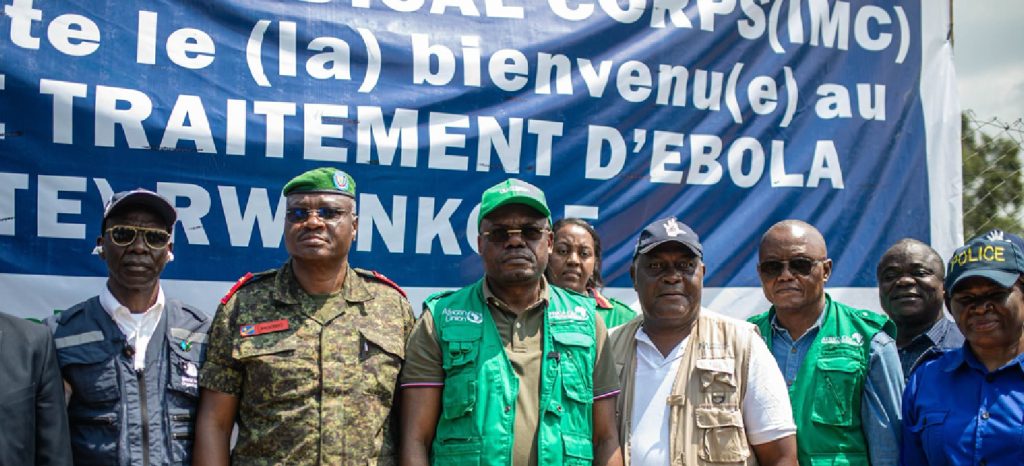
Addis Ababa, Ethiopia, 17 September 2026 – Four months after the Ebola outbreak caused by Bundibugyo virus in the Democratic Republic of the Congo was designated a Public Health Emergency of Continental Security (PHECS), the Africa CDC Emergency Consultative Group (ECG) has completed an independent scientific review and issued recommendations for the next phase of the response.
After reviewing the latest epidemiological, operational and scientific evidence, the ECG supports a position of cautious optimism. Declines in cases and deaths in some hotspots, including Ituri, are encouraging, but the situation remains heterogeneous, with increases in some health zones, particularly in North Kivu. The available data do not yet confirm that the outbreak has reached its peak. The Group therefore recommends maintaining the PHECS, scaling up response intensity, consolidating gains, addressing persistent community deaths and gaps in contact identification, strengthening community ownership, and protecting and restoring essential health services.
- Transmission: Declines in some hotspots, including Ituri, are encouraging, but active transmission and increases in some health zones, particularly in North Kivu, mean the available data do not yet confirm that the outbreak has reached its peak or that transmission has been sustainably interrupted.
- Level of control: Transmission is not yet consistently controlled across all affected areas. Persistent community deaths, gaps in contact identification and disruption of essential health services remain major concerns.
- Surveillance: Intensified surveillance is required in affected, newly affected and re-emerging health zones, with rapid reinforcement of response capacities when new infections are detected.
- Vaccination: Continue observational and other vaccine studies, strengthen informed consent on the uncertainty of protection against Bundibugyo virus, and continue generating effectiveness and safety evidence under approved protocols.
- PHECS status: Maintain the PHECS designation and continental-level coordination while monitoring progress against clearly defined criteria for eventual de-escalation.
- Immediate priorities: Scale up response intensity, especially in North Kivu; urgently reduce community deaths; strengthen contact identification, tracing and data quality; deepen community ownership; and fast-track the restoration of essential health services.
The Group assessed both the direction of the epidemic and the strength of the evidence supporting each conclusion.
Epidemic trajectory
The ECG supports cautious optimism. Improving trends in some health zones, including Ituri, are encouraging, but the pattern is not uniform and transmission remains active in parts of the affected area.
The assessment reflects decreases in cases and deaths in some hotspots alongside improvements in laboratory, treatment, community surveillance, contact tracing and other response capacities, while increases in some health zones, particularly in North Kivu, require continued response intensity.
The available data do not yet confirm that the outbreak has reached its peak. The Group cautioned against interpreting short-term declines as sustained interruption of transmission. New infections and re-emergence in health zones that had previously shown improvement require continued vigilance until sustained interruption is demonstrated across affected areas.
Level of control
The ECG concluded that transmission is not yet consistently controlled across all affected areas and that current gains remain vulnerable to reversal if interventions are relaxed too early.
The Group highlighted progress in response capacity while identifying persistent concerns: community deaths remain around 60% of reported deaths, gaps remain in the identification and completeness of contact lists, and the outbreak continues to disrupt essential health services.
It recommended maintaining and scaling up the response, protecting gains in laboratory and treatment capacity, community surveillance and contact tracing, and avoiding premature relaxation of interventions while transmission remains heterogeneous.
Surveillance in affected and re-emerging health zones
The ECG called for stronger contact identification and listing, noting that high percentages of contacts traced can mask gaps in the initial identification and completeness of contact lists.
The Group recommended prioritising the quality, completeness and timeliness of data reporting, while maintaining intensified surveillance in newly affected and re-emerging health zones and rapidly reinforcing response capacities when new infections are detected.
Vaccination and medical countermeasures
Following its review of the available scientific evidence, the ECG recommended continuing observational and other vaccine studies and continuing to generate effectiveness and safety evidence on vaccines used or evaluated in the response.
The Group advised that informed consent should clearly communicate that the level of protection against Bundibugyo virus remains under investigation, particularly for vaccines not specifically licensed against Bundibugyo virus disease. Additional vaccines may be evaluated in accordance with approved study protocols.
Recommendations for the next phase of the response
The ECG recommended that Africa CDC, the Government of the Democratic Republic of the Congo and response partners prioritise:
1. Maintain the PHECS status. Maintain the PHECS designation and continental-level response and coordination while monitoring progress against clearly defined criteria for eventual de-escalation.
2. Scale up response intensity and consolidate gains. Continue current efforts and reinforce response intensity, especially in North Kivu; protect strengthened response capacities and avoid premature relaxation of interventions while transmission remains heterogeneous.
3. Urgently address persistent community deaths. Intensify community engagement, early detection, referral, timely access to treatment and trust-building interventions to address the roughly 60% of reported deaths occurring in communities.
4. Strengthen community ownership and accountability. Move from awareness activities toward meaningful community participation in setting priorities and shaping local interventions, strengthening trust in surveillance, treatment and vaccination.
5. Strengthen contact identification, tracing and surveillance. Improve the completeness of contact identification and listing, data quality and timeliness, and sustain intensified surveillance in affected and re-emerging health zones.
6. Protect and restore essential health services. Fast-track free essential health services to restore immunisation, maternal and child health, antenatal care, nutrition and other primary health care services disrupted by the outbreak, and reduce secondary morbidity and mortality.
7. Continue generating evidence on vaccines. Continue observational and other studies, ensure clear informed consent on uncertainty around protection against Bundibugyo virus, and generate effectiveness and safety evidence under approved protocols.
“The evidence gives us grounds for cautious optimism, but it does not yet show consistent control across all affected areas. The response must remain at full intensity, with urgent attention to community deaths, complete contact identification and rapid action wherever transmission re-emerges,” said Prof. Salim Abdool Karim, Chair of the Africa CDC Emergency Consultative Group. “Sustained interruption of transmission has to be demonstrated before de-escalation is considered.”
H.E. Dr Jean Kaseya, Director General of Africa CDC, said Africa CDC would act on the ECG’s recommendations.
“The recommendation is clear: maintain the PHECS, consolidate the gains and close the gaps that continue to cost lives,” said Dr Kaseya. “Africa CDC will work with the Government of the Democratic Republic of the Congo, communities and partners to intensify the response, strengthen surveillance and contact tracing, restore essential health services and continue building the evidence needed to guide vaccination.”
The ECG is chaired by Prof. Salim Abdool Karim and comprises twenty senior African scientists and public health experts:
| Member | Member |
| Prof. Salim Abdool Karim, Chair | Prof. Helen Rees |
| Dr David Parirenyatwa | Prof. Lucille Blumberg |
| Prof. Jean-Jacques Muyembe | Prof. Francine Ntoumi |
| Prof. Rose Leke Fonbang | Prof. Jean Nachega |
| Dr Amadou Sall | Prof. Oyewale Tomori |
| Prof. Samba Sow | Prof. Dimie Ogoina |
| Prof. Abderahmane Maroufi | Prof. Maha El Rabbat |
| Prof. Samia Menif Marrakchi | Prof. Fawzi Derrar |
| Dr Sultani Matendechero | Prof. Nelson Sewankambo |
| Prof. Claude Mambo Muvunyi | Prof. Agnes Binagwaho |
Africa CDC continues to work with the Government of the Democratic Republic of the Congo, affected communities, WHO and response partners to implement the ECG’s recommendations and adapt operations as the epidemiological picture evolves.
About the Emergency Consultative Group
The Africa CDC Emergency Consultative Group is an independent body of senior African scientists and public health experts. It advises the Director General of Africa CDC during major public health emergencies. Its scientific advice has informed Africa CDC decisions throughout the Ebola response.
About Africa CDC
Africa CDC is the public health agency of the African Union. As an autonomous institution, Africa CDC supports AU Member States in strengthening health systems, improving disease surveillance, and enhancing emergency preparedness and response. For more information, visit: http://www.africacdc.org and follow Africa CDC on LinkedIn, X, Facebook, and YouTube.
Media enquiries: Directorate of Communications and Public Information, Africa CDC | Email: communications@africacdc.org