Advancing Health Security and Sovereignty: Strengthening Domestic Financing, Expanding Health Insurance and Accelerating Local Manufacturing
Co-hosted by Africa CDC and the Government of the Republic of Namibia
PREAMBLE
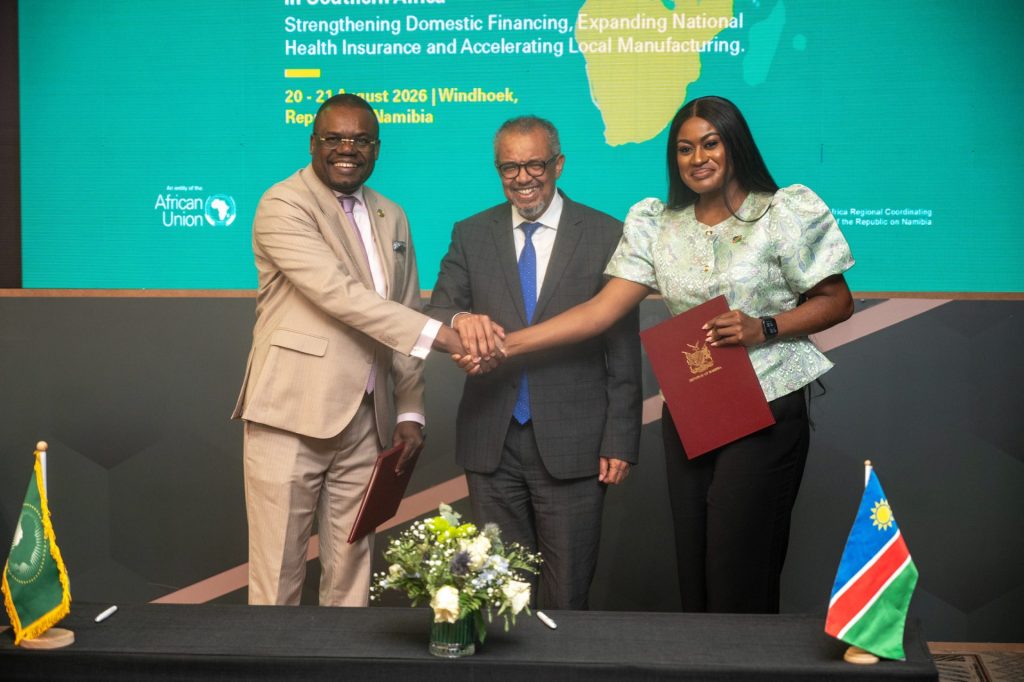
We, the Ministers of Health of Southern African Member States, together with Africa CDC, RECs, ReTAC, partners and stakeholders, met in Windhoek on 20–21 August 2026 under the theme: “Advancing Health Security and Sovereignty in Southern Africa.”
We thank Her Excellency Dr Netumbo Nandi-Ndaitwah, President of the Republic of Namibia, and the people of Namibia for their hospitality. We commend Africa CDC’s Southern Africa Regional Coordinating Centre (SARCC) for progress since the 4th ReSCO and reaffirm our commitment to translating regional commitments into concrete action for health resilience and sovereignty.
CONTEXT AND RECOGNITIONS
We commend Member States for leadership in Universal Health Coverage (UHC) and health security, including budget prioritisation, Public Finance Management reforms, strengthening NPHIs, EOCs, surveillance and cross-border preparedness.
We recognise progress toward UHC, with strong service coverage and lower out-of-pocket reliance than in many regions. However, health budget shares remain below the 15% Abuja target, eroded by inflation, currency depreciation and population growth. Uneven execution, delayed releases and limited facility-level financial visibility prevent full translation into service readiness. Declining external assistance risks widening gaps and reversing gains unless addressed by country-led transition plans, with domestic public financing as the foundation.
We recall AU Agenda 2063, the Abuja Declaration, the Africa Health Strategy, Africa CDC Strategic Plan, the Africa Health Security and Sovereignty Agenda, the Lusaka Agenda, and AU decisions on financing, manufacturing and pooled procurement.
We note with concern declining Official Development Assistance (ODA), fiscal pressures and high external dependence, fragmented demand, limited financing and technology transfer and uneven regulatory capacity continue to impede sustainable local manufacturing.
We welcome the Southern Africa Directors of Planning and Policy Forum and the Health Economics, Financing and Public Financing Management Think Tank, supported by Africa CDC, as regional public goods for policy leadership, peer learning and African-owned evidence.
WE COMMIT TO:
- Manage transition to sustainable financing – Develop costed country transition plans; conduct joint annual reviews by Health and Finance; and bring external financing within a country led One Plan, One Budget and One Report Framework.
- Expand domestic public financing – Maintain general taxation as the foundation; progress toward 15% of government real budgets; assess earmarked taxes for additionality, equity and feasibility.
- Strengthen financing and PFM from centre to frontline – Improve budget credibility, timely releases and facility-level financial visibility; provide primary care facilities with predictable operating budgets and accountability.
- Advance UHC through integrated prepayment – Expand pooled prepayment and reduce out of pocket expenditure. Preserve tax-funded entitlement; where National Health Insurance/Social Health Insurance is used; design it complementarily for non-poor informal groups; avoid fragmentation; strengthen strategic purchasing.
- Accelerate local manufacturing and pooled procurement – Promote regional production; strengthen value chains, technology transfer and skills; harmonise regulation; support the African Pooled Procurement Mechanism.
- Advance regional owned thought leadership – Operationalise the Southern Africa Directors of Planning Forum and Health Economics, Financing and PFM Think Tank.
WE CALL UPON
- Member States: Exercise whole-of-government leadership; treat health as strategic investment; advance the continental immunization priorities in the region; lead transition plans; select pooling arrangements contextually, with tax-funded entitlement as foundation.
- RECs (SADC, COMESA): Incorporate commitments into regional strategies; advance harmonisation, supply chains and pooled procurement.
- Africa CDC: Provide coordinated technical support; operationalise the Forum and Think Tank; monitor progress and report to ReSCO.
- Partners: Respect government leadership; align with national plans; ensure transparent, orderly transitions; invest in enduring capacity.
- Private sector, academia, civil society: Contribute to manufacturing, innovation, evidence and accountability.
WE REQUEST AFRICA CDC TO
- Provide sustained implementation support in health financing
- Operationalise the Directors Forum and Think Tank with governance and annual workplans.
- Operationalise the Lusaka Agenda Monitoring Framework at country and regional levels; align indicators and avoid parallel systems.
- Support sustainable NPHI and PHEOC establishment, including costing and budget integration.
- Accelerate readiness for the African Pooled Procurement Mechanism.
- Facilitate structured coordination, knowledge exchange and peer learning.
- Prepare a country-validated regional progress report for each ReSCO meeting.
REAFFIRMATION
We reaffirm our commitment to UHC, health security and sovereignty, founded on domestic public financing, strong PFM, integrated systems, and context-appropriate prepayment. We will use NHI/SHI and innovative finance as complements, strengthen primary care, Human Resources for Health (HRH), supply chains and regional institutions, and advance African ownership of financing, evidence and policy leadership.
We express gratitude to Her Excellency Dr Netumbo Nandi-Ndaitwah, President of the Republic of Namibia, and people of the Republic of Namibia, Africa CDC, SARCC Secretariat, RECs, development partners, delegates and all stakeholders whose invaluable contributions ensured the successful convening of the 5th Southern Africa Regional Ministerial Steering Committee (ReSCO) Meeting.
Adopted in Windhoek, Republic of Namibia, on this 21st day of August 2026.
.