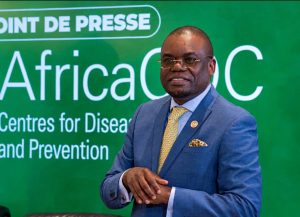
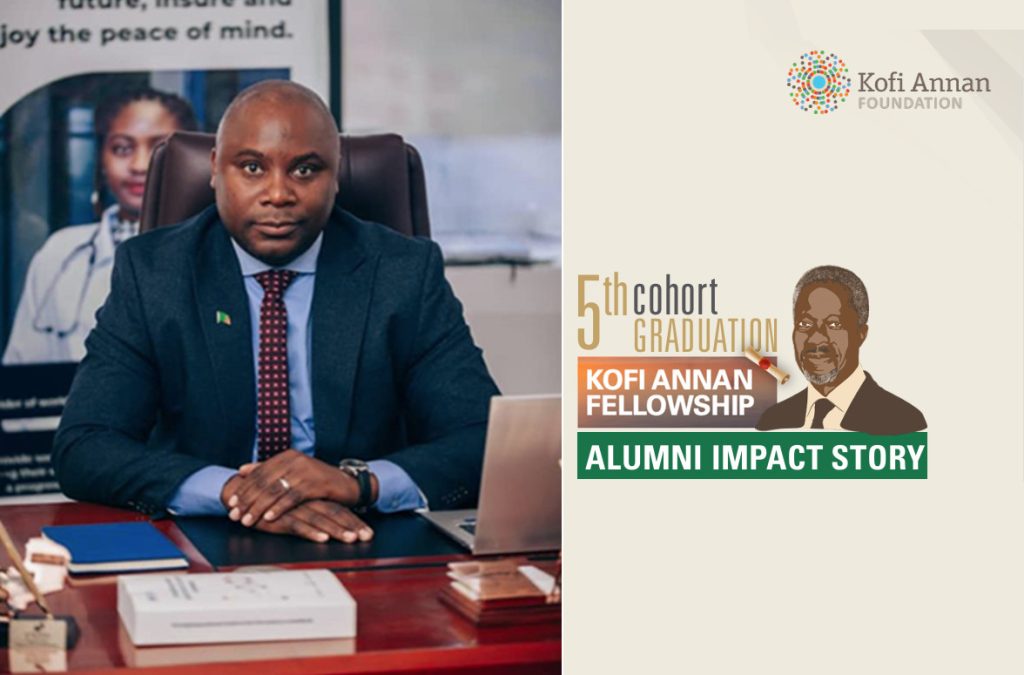
Currently serving as the Director of Research Planning and Strategy at Zambia’s National Health Insurance Management Authority (NHIMA), Herryman Moono graduated from the Kofi Annan Fellowship in Global Health Leadership Program (KAF-GHLP) in 2023.
He joined the 2022–2023 Kofi Annan Fellowship in Global Health Leadership Program (KAF-GHLP) with a clear mission. Drawing on his background in healthcare finance, including a previous role as a social policy specialist at the UN, he sought to sharpen his leadership skills to address a critical challenge: extending Universal Health Coverage (UHC) to Zambia’s underserved populations through the national health insurance scheme.
A key realization for Herryman during the fellowship was that leadership goes beyond technical expertise. This shifted his approach toward leadership as “less of a technical issue but more about team building, creating partnerships, identifying talent, and motivating people to deliver on the objective.”
Herryman’s Leadership Challenge Project (LCP) became a direct application of these skills, focusing on strategies to extend healthcare insurance coverage to Zambia’s most vulnerable populations. He developed a concept paper inspired by Rwanda’s initiatives and submitted it to the Global Fund. At the time, this was considered “a long shot,” as it had “never been done before in Zambia” and NHIMA was still a new institution.
By the time he graduated, Herryman had secured an impressive 1.5million already disbursed in Global Fund support to pilot his LCP. This project has since achieved remarkable success, registered 20,000 households and benefited approximately 100,000 individuals with NHIMA services. Crucially, it also created employment for 35 people in the field. With the success of the Global Fund supported pilot, Herryman secured an additional US$2.5 million from international partners, extending coverage to over 60,000 poor and vulnerable households benefiting over 250,000 individuals. Upon returning, he was tasked with managing two directorates simultaneously for over a year, a challenge he embraced by applying his strengthened delegation and leadership skills. His work has also expanded into policy advocacy, including presenting a paper to the Global Fund on the burden of malaria on the national health insurance scheme, advocating for strategic investment in preventive services to ensure sustainability and reduce healthcare costs.
Herryman continues to champion a broader public health approach, emphasizing that health crises such as cholera outbreaks are fundamentally issues of leadership requiring multi-sectoral responses that address social determinants like water and sanitation. He also advocates for a shift from “medicine-centric” and “sickness systems” to true healthcare systems that prioritize prevention.
His influence extends beyond NHIMA. His project contributed to Human Resources for Health development through job creation, and his leadership trajectory has continued to rise. Just two years after the fellowship, he was elected Vice President of the African Federation of Public Health Associations (AFPHA) and now serves on the WHO UHC 2030 Steering Committee and the ILO Global Tripartite Advisory Committee in Geneva. He also remains actively engaged with fellow alumni, strengthening the program’s continental network.
For future cohorts, Herryman emphasizes the importance of aligning Leadership Challenge Projects with real organizational needs, noting that this ensures internal ownership, sustainability, and greater impact because “you’re actually addressing a challenge in the organization.”