Addis Ababa, Ethiopia | 6 May 2026 — Africa Centres for Disease Control and Prevention (Africa CDC), the African Society for Laboratory Medicine (ASLM) and the European Union have launched the Advancing Regional Integrated Laboratory Capacity for AMR Control (ARILAC) initiative, a four-year project to strengthen microbiology laboratory systems, AMR surveillance and integrated One Health data use across Africa.
As antimicrobial resistance (AMR) remains one of the most pressing global public health threats, with serious implications for health systems, food security and economic stability, ARILAC will support Member States to strengthen microbiology laboratory capacity for AMR surveillance and clinical care.
Africa CDC and ASLM will implement the ARILAC project as part of the Team Europe Initiative with Africa on Sustainable Health Security, using a One Health approach to contribute to broader efforts to combat AMR and strengthen the One Health workforce. Eight African Union Member States — Cameroon, Chad, Ethiopia, Gabon, Mozambique, Sierra Leone, Uganda and Zimbabwe — will participate in the project over 48 months.
ARILAC aims to improve microbiology laboratory capacity for the surveillance, prevention and control of AMR through an integrated, systems-strengthening One Health approach at national, regional and continental levels. The project will strengthen laboratory infrastructure, equipment management, access to essential microbiology supplies, laboratory quality management systems, genomic surveillance, data systems and the technical skills of laboratory experts working across human and animal health sectors. These priorities are designed to generate reliable, representative and timely AMR data to inform clinical care, national action plans and continental AMR control strategies.
Africa continues to face a major diagnostic gap. A multi-country study led by Africa CDC and ASLM found that, among more than 50,000 medical laboratories assessed in 14 African countries, only 1.3% conduct routine bacteriological testing for AMR priority pathogens, leaving more than 261 million people without access to AMR testing services.
“Without targeted investment, this gap is expected to widen as populations grow. Only 20% of these laboratories currently use automated systems for pathogen identification or antimicrobial susceptibility testing, which limits timely diagnosis and weakens evidence-based treatment,” said Dr Yenew Kebede, Acting Director, Centre for Laboratory Diagnostics and Systems, Africa CDC. “ARILAC responds directly to this challenge by strengthening laboratory networks, introducing modern technologies, improving quality assurance and connecting laboratory data to national and continental AMR surveillance systems.”
Through ARILAC, ASLM will support participating Member States to strengthen their AMR laboratory systems in a practical and sustainable way, said Mr Nqobile Ndlovu, ASLM Chief Executive Officer. “The project will support laboratory assessments, updated surveillance guidelines, supervision, mentorship and participation in regional quality assessment schemes. It will also improve biobanking capacity and expand access to automated systems for bacterial identification, antimicrobial susceptibility testing and blood culture,” he said.
Dr Mesay Hailu, Director General of the Ethiopian Public Health Institute (EPHI), speaking on behalf of the host country and participating Member States, emphasised the importance of ARILAC in supporting the implementation of national action plans for AMR and reaffirmed EPHI’s commitment to the success of the project.
“Team Europe is proud to support ARILAC as part of its commitment to sustainable health security and stronger One Health systems in Africa,” said Mr Gianluca Azzoni, Head of Policy and Cooperation, EU Delegation to the African Union. “By investing in laboratory capacity, skilled professionals and interoperable surveillance systems, the project will help Member States detect AMR earlier, generate better evidence and act more effectively to protect lives and livelihoods.”
Dr Claudes Kamenga, Chief of Staff and Head of the Executive Office, Africa CDC, who officially launched the project on behalf of H.E. Dr Jean Kaseya, Director General of Africa CDC, emphasised the importance of addressing sustainability from the project design phase. He called upon Member States to take full ownership, drive implementation at the national level and ensure that laboratory systems established under this project are integrated into national budgets to ensure long-term impact. He reaffirmed Africa CDC’s commitment to providing leadership and continental coordination for the success of the project.
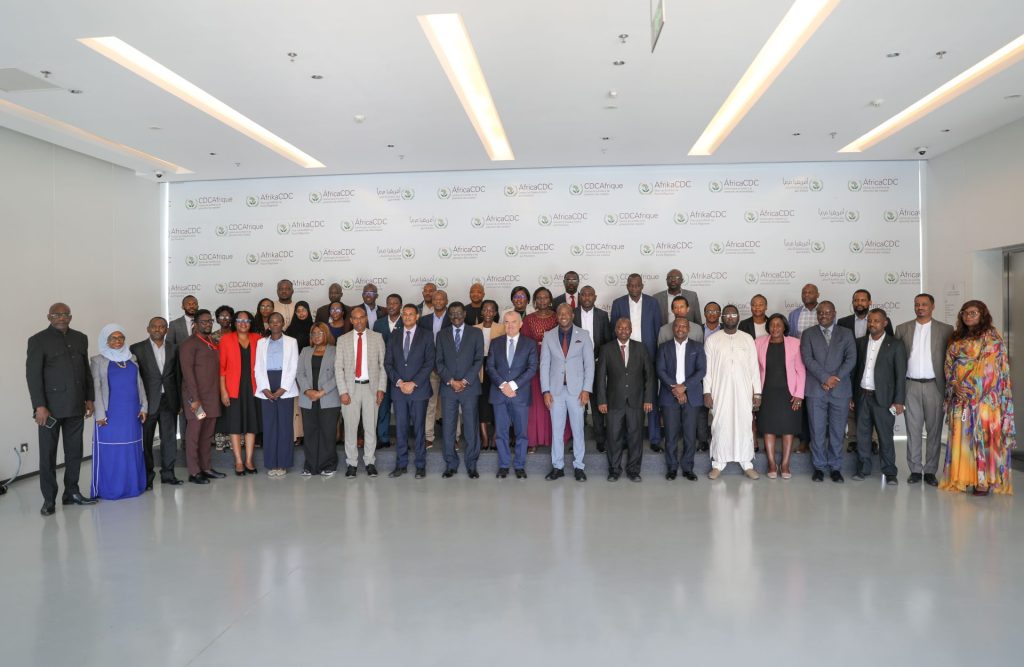
The two-day kick-off meeting, held from 6 to 7 May 2026 at Africa CDC headquarters in Addis Ababa, brought together representatives from national public health institutes, national clinical and veterinary microbiology reference laboratories, AMR surveillance systems, regional organisations and development partners. Participants aligned on project objectives, roles and responsibilities, implementation approaches, work plans, reporting timelines and mechanisms for sustained collaboration.
The launch marks a significant step towards stronger, better-connected and more resilient microbiology laboratory networks in Africa. By linking laboratory modernisation, quality assurance, workforce development and One Health data use, ARILAC is expected to support more timely AMR detection, stronger surveillance, improved evidence for antimicrobial stewardship and better preparedness for emerging health threats across the continent.
###
About Africa CDC
The Africa Centres for Disease Control and Prevention (Africa CDC) is the public health agency of the African Union. As an autonomous institution, Africa CDC supports AU Member States to strengthen health systems, improve disease surveillance, and enhance emergency preparedness and response. For more information, visit: http://www.africacdc.org and follow Africa CDC on LinkedIn, X, Facebook, and YouTube.
About the African Society for Laboratory Medicine (ASLM)
The African Society for Laboratory Medicine (ASLM) is a pan-African organization dedicated to improving laboratory services and systems across the continent. ASLM works in partnership with governments, international organizations, and healthcare providers to enhance laboratory capacity and improve health outcomes.
Media Contacts
Africa CDC: Margaret Muigai Edwin, Director of Communication & Public Information Directorate: Africa CDC | Tel: +255 742 635 592, edwinm@africacdc.org
ASLM: Nelly Rwenji | Senior Brand and Communications Manager, ASLM | Email: NRwenji@aslm.org