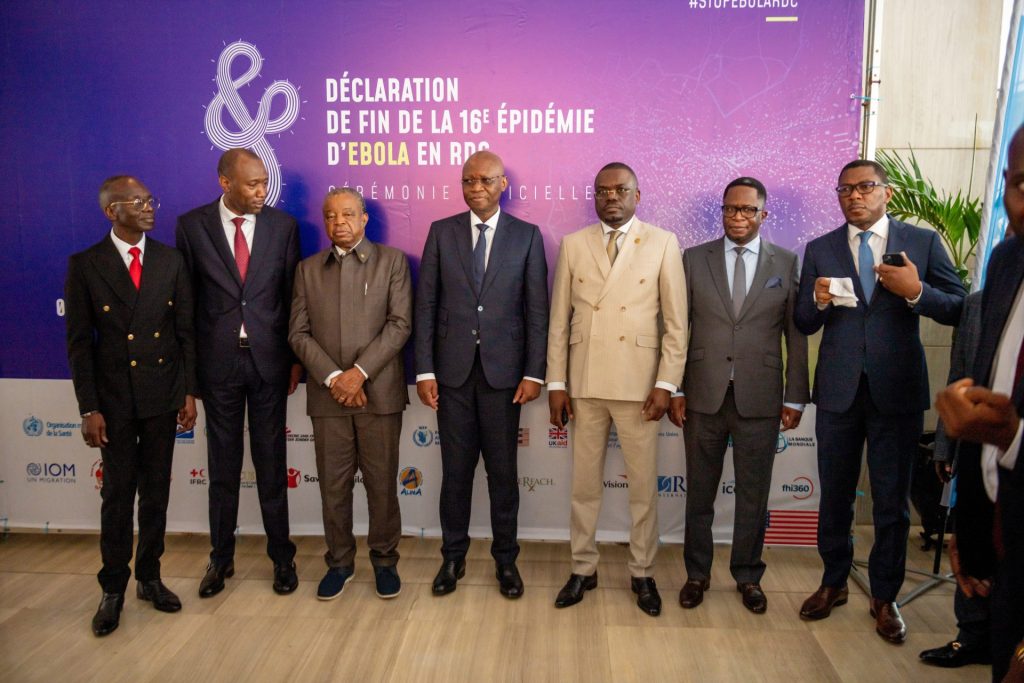
Kinshasa, 1 December 2025 – The Ebola outbreak in the Democratic Republic of Congo (DRC) has been declared over after 42 days without any new cases and following the recovery of the last confirmed patient.
“This success is the result of exceptional determination and exemplary coordination,” said Dr Jean Kaseya, Director General of the Africa Centres for Disease Prevention and Control (Africa CDC).
He commended the DRC Government, the leadership of Health Minister Dr Roger Kamba, the efforts of the country’s National Institute of Public Health (INSP), as well as the support of technical and financial partners, field teams and the communities, “whose courage continues to inspire our continent.”
The outbreak, the 16th recorded in the DRC to date, was centred in Kasai Province and was declared on 4 September 2025. It began with an index case – a 34-year-old pregnant woman admitted with high fever and repeated vomiting.
Laboratory tests confirmed the Zaire strain of Ebola. At the time of declaration, 15 deaths and 28 suspected cases were reported across Bulape and Mweka health zones, including four healthcare workers.
Since then, 53 confirmed cases, 11 probable cases and 34 deaths among confirmed cases were reported. This brings the likely total deaths to 45, according to INSP Head, Dieudonne Mwamba Kazadi.
All confirmed cases were from the Bulape Health Zone. The last active case was discharged from a treatment centre on 19 October 2025, marking the start of the 42-day countdown.
Thanks to intense surveillance, community engagement, extensive vaccination and preparedness efforts, no new cases have been detected since then. The Ministry of Health, in collaboration with Africa CDC and partners, continues to monitor the situation closely and urges communities to remain vigilant.
Vaccination played a critical role in controlling the outbreak. Over 48,000 vaccines were deployed, with more than 44,400 persons being vaccinated, including frontline health workers and high-risk contacts.
Dr Kaseya emphasised the importance of learning from every outbreak, stating that managing an epidemic does not end when the outbreak ends, but rather “it is at that moment that the most decisive work begins.”
He added: “Every outbreak must be rigorously documented – what worked, what failed, what shifted the trajectory, and what needs improvement. These analyses strengthen alert systems, reinforce laboratories, optimise coordination, mobilise communities and guide risk communication. They also reveal the true impact on families, economies and social cohesion. For this work, Africa CDC will stand with you.”
Dr Kaseya also announced the allocation of USD1 million to enable the Director of Africa CDC’s Science and Innovation Division to begin work next week, in collaboration with the DRC’s Ministry of Health, INSP, the World Health Organization and other partners, on comprehensive post-epidemic studies.
About the Africa CDC
The Africa Centres for Disease Control and Prevention (Africa CDC) is a public health agency of the African Union. It is autonomous and supports member states in strengthening health systems. It also helps improve disease surveillance, emergency response, and disease control. Learn more at: http://www.africacdc.org and connect with us on LinkedIn, Twitter, Facebook and YouTube
Media Contacts
Margaret Edwin Director of Communication and Public Information: EdwinM@africacdc.org