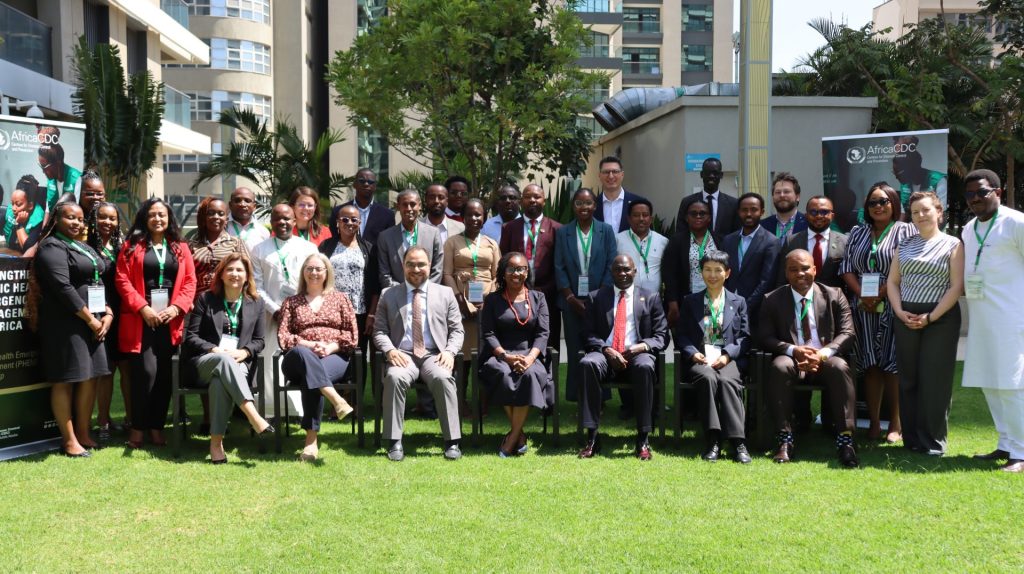
- The 3rd Technical Advisory Committee (TAC) Meeting of the Africa CDC Public Health Emergency Management (PHEM) Fellowship was held on 26th -27th January, at the Pan Pacific Serviced Suites, West-lands, Nairobi, Republic of Kenya.
- The gathering brought together experts and representatives from Africa CDC (HQ and RCC), Robert Koch Institute (RKI), UK Health Security Agency (UKHSA), WHO Regional Offices (AFRO and EMRO), WHO Headquarters, European Centres for Disease Prevention and Control (ECDC), Georgetown University, African Public Health Foundation (APHF), US-CDC, AFENET, Association of Schools of Public Health (ASPPH), Africa CDC PHEM Fellowship fellows and PHEM experts from Member States.
- The meeting aimed to review progress and performance of the fellowship, provide strategic guidance for the continuous improvement, and update the fellowship training curriculum so that it reflects today’s realities – emerging public health threats, evolving emergency management practices, and the operational needs of African health systems.
- TAC meeting was chaired by Dr. Wessam Mankoula (Northern RCC Coordinator and Ag Head, Emergency Preparedness and Response Division while the Director of the Eastern RCC, Dr. Lucy Mazyanga declared the TAC meeting open.
- TAC partners strongly commended Africa CDC for its leadership in establishing the fellowship program and its commitment to developing the next generation of public health emergency management leaders. They also emphasized the need to expand partnerships to ensure the program’s sustainability.
- TAC technical partners were commended for their continued support in capacity building and in strengthening emergency preparedness and response across Africa, as well as for their ongoing collaboration with Africa CDC to strengthen the PHEM Fellowship Program.
- TAC members reaffirmed their commitment to supporting AU Member States in strengthening public health emergency preparedness and response capabilities through competency-based workforce development and sustained technical engagement to continuously improve the PHEM Fellowship Programme.
- TAC emphasized the need to position the Fellowship as a continental laboratory for applied PHEM evidence generation by establishing structured mechanisms to curate practice-based PHEM evidence.
- TAC tasked the Secretariat to work on an impact report to enhance visibility and relevance of the program.
- TAC recognized key achievements of the fellowship program, including the successful completion of the second cohort, the robust mentorship program and the introduction of new initiatives to further enhance learning.
- TAC reviewed the program performance report of Cohort 2 presented by the secretariat and affirmed that deliberate efforts have been made to implement all previous TAC decisions.
- TAC acknowledged the expanding spectrum of public health threats in Africa -including epidemic-prone diseases, climate-related hazards, conflict, displacement, and non-communicable disease emergencies-and highlighted the implications of the health emergency architecture for workforce development.
- TAC emphasized the need to advance the One Health approach, integrate climate change and Multisectoral coordination into the training modules.
- TAC emphasized the importance of building leadership, workforce resilience, and community engagement in emergency response, while harnessing digital innovations and blended learning across the training program.
- TAC stressed the need to expand practice-based learning opportunities and to advance the fellowship from initial roll-out to scaled, sustainable implementation while maintaining excellence.
- TAC emphasized the need for the curriculum to be updated to reflect emerging epidemic threats, climate risks, and humanitarian contexts, incorporate more Africa-relevant case studies.
- TAC further noted that the curriculum expand One Health content through practical scenarios, and strengthen social and behavioral science components, including risk communication and community trust.
- TAC reiterated the need for the program to make simulation exercises a core learning approach, incorporate virtual and blended learning including digital simulations, and introduce field-based practicums in PHEOCs, cross-border activities, and Multisectoral platforms.
- TAC advocated for the program to deepen collaboration with NPHIs, universities, disaster management agencies, and RCCs, while strengthening country ownership through co-financing, mentorship, and accreditation pathways.
- TAC proposed for lessons from simulations and deployments to be used to inform fellowship administration, with systematic tracking of improvement plans linked to fellowship outputs.
- TAC was unanimous in its decision that the success of the PHEM Fellowship should be measured by its sustained country-level impact, reflected in fellows’ professionalism and communication during emergencies, their active engagement in preparedness and response, alumni contributions to resilient public health emergency management systems, using key indicators such as growing demand, diversity of trained cadres, high-quality training materials, strengthened mentorship and PHEOC networks, and systematic tracking of alumni placement, influence, and participation in emergency response and cascade training.