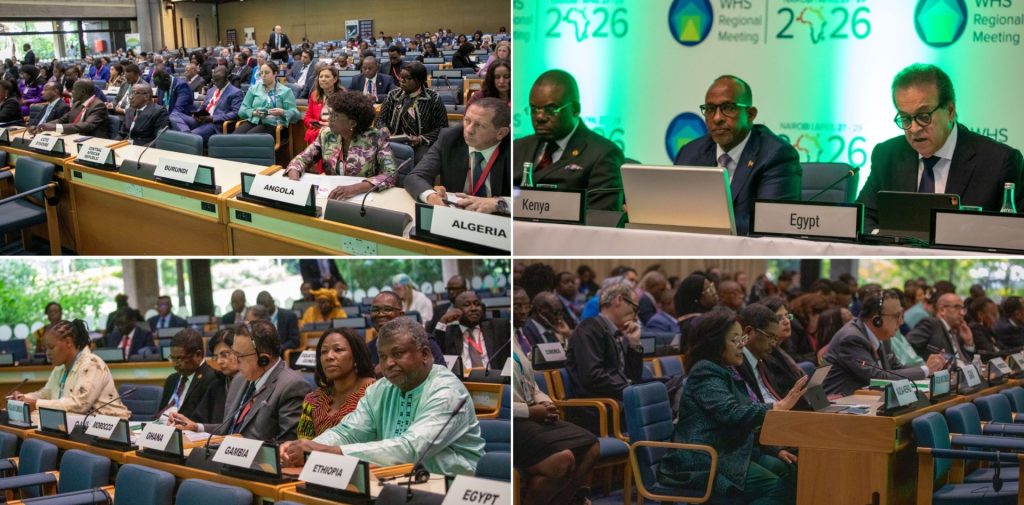
Nairobi, Kenya | 27 April 2026 — Africa Centres for Disease Control and Prevention (Africa CDC) today launched the African High-Level Ministerial Committee on Global Health Architecture Reform (AHLMC) on the margins of the World Health Summit Regional Meeting 2026 in Nairobi, Kenya.
The Committee brings together Ministers of Health and Finance from across the continent to consolidate Africa’s voice, strengthen political coordination, and advance a unified African position on global health governance reform. It is designed to provide stewardship, strategic coherence, and accountability for Africa’s engagement across interconnected reform processes, including the Pandemic Agreement and related annexes, International Health Regulations implementation discussions, UN80-linked reforms, and wider global health financing debates.
“Africa carries a disproportionate burden of disease, yet its voice in global decision-making remains limited,” said H.E. Mahmoud Ali Youssouf, Chairperson of the African Union Commission (AUC). “This is not sustainable, and it is not acceptable. With the Committee, we will speak with one voice—stronger, clearer, and more influential—in shaping global health policies.”
The launch comes at a pivotal moment for global health. Recent crises—including COVID-19, mpox, cholera, Marburg outbreaks, antimicrobial resistance, and climate-related health risks—have exposed structural inequities in access to medical countermeasures, technology transfer, data, and financing. At the same time, declining external support is placing additional pressure on African health systems. Speakers warned that Official Development Assistance for health fell by an estimated USD 31.1 billion in 2025, with further reductions expected in 2026, underscoring the urgency of more resilient, equitable, and better-aligned health governance and financing arrangements.
Against this backdrop, Africa is charting a new path, moving from fragmented engagement to coordinated continental action, with the AHLMC serving as a political vehicle for more systematic engagement in global rule-setting and financing processes.
Speaking at the launch, H.E. Dr Jean Kaseya, Director General of Africa CDC, underscored the urgency of reforming global health systems to reflect Africa’s priorities, realities, and ambitions. “The old model is no longer fit for purpose. Africa cannot continue to be a passive recipient of global health decisions. This Committee is about power, voice, and ownership, ensuring that Africa acts collectively and shapes the systems that determine our future.”
The AHLMC is a central pillar of Africa’s Health Security and Sovereignty agenda and will drive action across five thematic workstreams: leadership reform and governance; financial sovereignty; data sovereignty and digitalisation; product sovereignty and local manufacturing; and pandemic prevention, preparedness, and response. Across these areas, the Committee will help define a consolidated African reform platform, coordinate ministerial engagement, develop guidance on common negotiating positions, and support reforms that strengthen African representation, reduce duplication, align financing, and reinforce continental institutions.
The Committee will serve as a high-level platform to translate political commitment into concrete outcomes, including coordinated African positions in global negotiations, strengthened domestic financing, and expanded access to essential health products.
“The establishment of the High-Level Committee is timely and necessary. It signals that Africa is organising itself with purpose, coherence, and a united voice to influence reform of the global health architecture,” said Ellen Johnson Sirleaf, Chair of the Committee.
“This moment is not about rhetoric; it is about responsibility. That means ensuring health funding is predictable and aligned with national priorities; strengthening institutions so that primary healthcare, data systems, and workforce capacity are foundational; and advancing equity, so that access to vaccines and technology is guided not by geography, but by humanity.”
Dr Kaseya further emphasised that the initiative marks a decisive shift towards implementation and accountability. “This is not another structure. It is an instrument for action, one that will transform ambition into results felt by our people.”
Although Africa continues to face major gaps in financing, manufacturing capacity, and access to essential health services, the AHLMC seeks to address these challenges by aligning national priorities, strengthening institutions, and mobilising collective action across the continent.
The Committee’s work will be results-oriented. Expected outputs include a consolidated African Position Paper on global health architecture reform, engagement and negotiation packages for priority global processes, a Reform Roadmap 2026–2030, a Financing Alignment and Mutual Accountability Framework aligned with the “One Plan, One Budget, One Report” approach, and regular progress reports to Africa CDC governance organs and African Union policy organs.
“We welcome our partners, but on a new basis: not as donors and recipients, but as equal partners aligned with Africa’s priorities,” said Dr Kaseya.
The World Health Summit Regional Meeting 2026 provides a critical platform to advance Africa’s health priorities and mobilise high-level political commitment for sustained action.
###
About Africa CDC
The Africa Centres for Disease Control and Prevention (Africa CDC) is the public health agency of the African Union. As an autonomous institution, Africa CDC supports AU Member States to strengthen health systems, improve disease surveillance, and enhance emergency preparedness and response. For more information, visit: http://www.africacdc.org and follow Africa CDC on LinkedIn, X, Facebook, and YouTube.
Media Contact Africa CDC:
Margaret Muigai Edwin, Director of Communication & Public Information Directorate: Africa CDC | Tel: +255 742 635 592, edwinm@africacdc.org