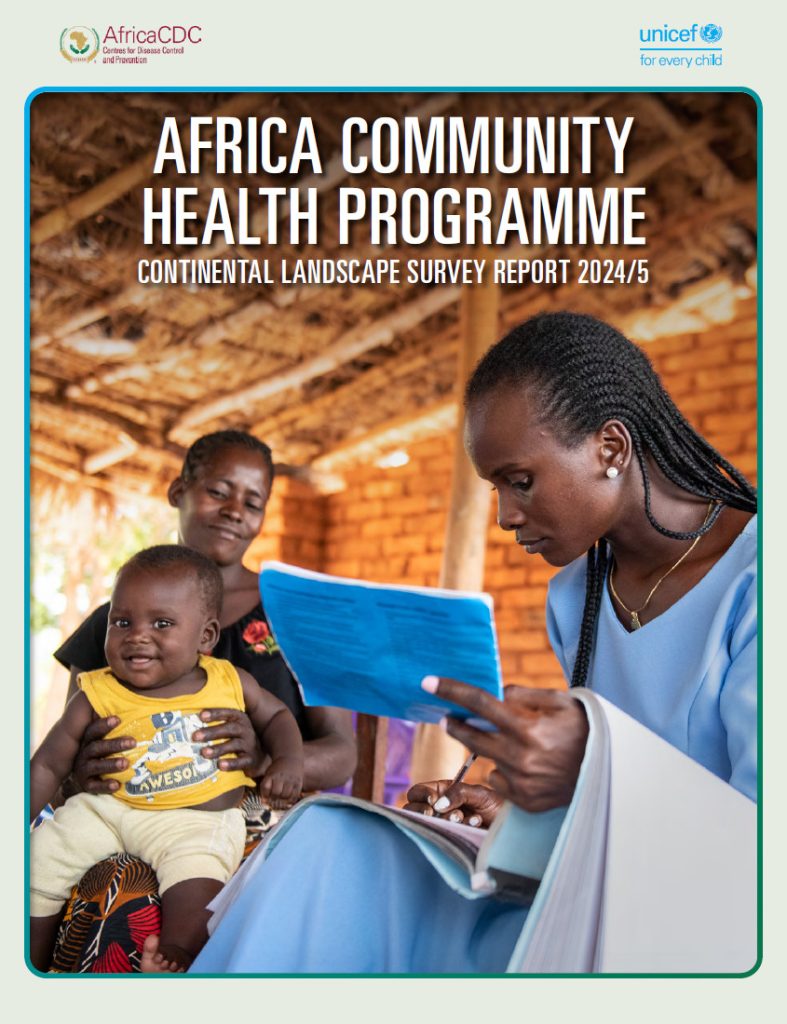
Africa Community Health Programme | Continental Landscape Survey Report 2024/5
EXECUTIVE SUMMARY
Community health systems, grounded in trust, local participation and culturally responsive service delivery, are central to achieving universal health coverage (UHC), enhancing Primary Health Care (PHC) and ensuring public health security across the African continent. Community Health Workers (CHWs), as the anchors of these systems, extend lifesaving services to remote and underserved populations, serving as frontline responders in both routine care and emergency contexts.
In November 2024, the Africa Centres for Disease Control and Prevention (Africa CDC), in collaboration with UNICEF, conducted a continent-wide survey on the status of community health in Africa. This survey presents a comprehensive overview of the state of community health on the continent, as well as the existing challenges and opportunities. Additionally, the survey offers a snapshot of national progress and gaps related to community health. As a foundational step towards regular monitoring and tracking of continental and country progress, the survey results will be visualized through a dashboard and scorecard that will be routinely updated to improve stakeholder accountability and inform the Africa CDC’s strategic interventions in achieving UHC and supporting resilient health systems in Africa.
1.1 SURVEY METHODOLOGY
Launched in November 2024 and validated in 2025, the survey constitutes a foundational milestone in the development of Africa CDC’s Community Health Data Platform and the Community Health Delivery Partnership’s (CHDP) global community health dashboard, aimed at enabling dynamic monitoring and decision-making, tracking progress, and improving stakeholder accountability. The data collection instrument was co-designed with technical experts from the African Union, Africa CDC, UNICEF, Member States, and other partners of the Community Health Continental Coordination Mechanism (CCM) Technical Working Group, aligned with the Africa CDC Community Health Workforce Strategic Priorities, WHO guidance, and UNICEF benchmarks.
It consisted of quantitative and qualitative questions across seven domains:
Policy, Strategy and Governance
Finance and Sustainability
Community Health Workforce
Service Provision (delivery)
Supplies and Equipment
Health Information Systems and Digitization
Community Engagement
Download Files
File
Action
Africa Community Health Programme | Continental Landscape Survey Report 2024/5
We use cookies to ensure that we give you the best experience on our website. If you continue to use this site we will assume that you are happy with it.