
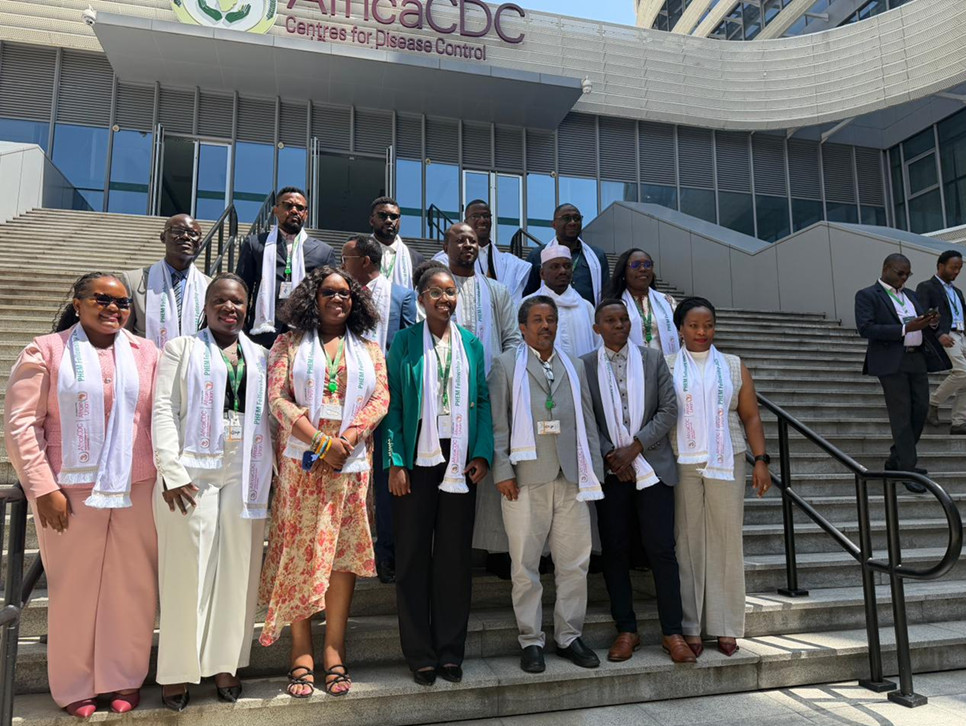
CONTEXT
Combating the several public health threats across the African continent requires adequately trained and equipped workforce. The Africa Health Security and Sovereignty (AHSS) Agenda has called for self-sustaining health security program that includes workforce development. The call is in alignment with the vision of the African Union (AU) and its desire to build capacity in public health through medium- and long-term training in identified areas of need. The establishment of the six-month Africa CDC Public Health Emergency Management (PHEM) fellowship provides a pathway for developing a cadre of skilled workforce that is capable of initiating and leading emergency management programs that include timely detection and response to emergencies whenever they occur. African public health professionals who are working within government institutions are strongly encouraged to apply.
GOAL
To develop a cadre of African public health workforce who are highly skilled to coordinate and lead preparedness and response to public health emergencies in Africa.
- Provide fellows up-to-date knowledge regarding public health emergency management and Public Health Emergency Operations Centers (PHEOCs)
- Provide fellows in-depth exposure to the role of PHEOCs in preparing for and responding to various public health emergencies
- Building the skills of fellows in managing the various functions of PHEOC, and leading the response to public health emergencies
- Institutionalize a sustainable program for PHEM on the African continent
FELLOWSHIP DESCRIPTION:
Overview:
The PHEM Fellowship will target mid-career African public health professionals with experience managing PHEOCs or leading emergency preparedness and response programs drawn from African Union member states. The Fellows shall be taken through a standardized training, structured mentorship, hands on experience, and technical assistance program leveraging on the PHEM Fellowship design of the US-CDC. During the training, Fellows will receive specialized training in public health emergency management functions and
operations, participate in study tours, work within Africa CDC EOC, take part in public health exercises and responses and receive guidance from global specialists in emergency management. Upon completion and return to home countries, Fellows will be expected to facilitate the expansion of public health emergency management programs within their home countries and sufficiently capacitated to take up leadership and advisory roles in public health emergency management programs.
Fellowship Structure:
The PHEM fellowship is a 6-month residential program requiring full-time commitment from selected Fellows. The third cohort will span two training sites: the Africa CDC Headquarters in Ethiopia and the Southern Regional Collaborative Centre in Zambia. The program starts with fourteen weeks of in-person classes, where Fellows are paired with experienced mentors to enhance their learning. This is followed by two weeks of study tours, with each Fellow visiting one PHEOC within Africa and one outside it. Afterward, Fellows will engage in a four-week field placement in PHEOCs and emergency response settings. The program concludes with four weeks for project completion, evaluations, and graduation.
Target Audience:
The fellowship is designed for mid-level public health professionals with experience in managing public health emergency operations centres or leading emergency preparedness and response programs in their countries.
Selection Criteria
Applicants must:
- Be citizens of an African Union Member State;
- Age Limit: Only professionals who will be 50 years old or younger by July 31, 2026, may apply;
- possess a postgraduate degree in public health or related field; have relevant professional experience in any field related to public health including but not limited to PHEOC operations, one health, medicine, finance, logistics and supply chain, health economics, health policy, animal health or environmental health;
- Be a full-time government-employed civil servant working in public health at a public institution in Africa.
- be able to demonstrate potentials to implement public health emergency management programs that can positively impact their countries upon return.
Selection shall be carried out by an independent committee comprising of experts from the African Union Commission and Africa CDC, and technical partners.
Selection process will be merit-based and emphasize an equal opportunity approach to ensure the representation of underrepresented groups.
Site allocation is solely at the discretion of Africa CDC.
Important Note:
- Candidates from less represented countries within the African Union are strongly encouraged to apply. These countries include Algeria, Benin, Botswana, Burkina Faso, Burundi, Cape Verde, Central African Republic, Chad, Comoros, Côte d’Ivoire, Djibouti, Egypt, Equatorial Guinea, Eritrea, Eswatini, Gambia, Ghana, Guinea-Bissau, Libya, Madagascar, Malawi, Morocco, Namibia, Niger, Rwanda, Sahrawi Democratic Republic, São Tomé and Príncipe, Seychelles, South Africa, South Sudan, Togo, Tunisia, and Zambia.
Important Dates:
- Deadline for Applications: 31 March 2026
- Successful applicants will be informed by May 2026
- The fellowship will start in June 2026
For more information, please download the brochures.
Application link: https://impact.africacdc.org/form/phem-fellowship-cohort-iii