
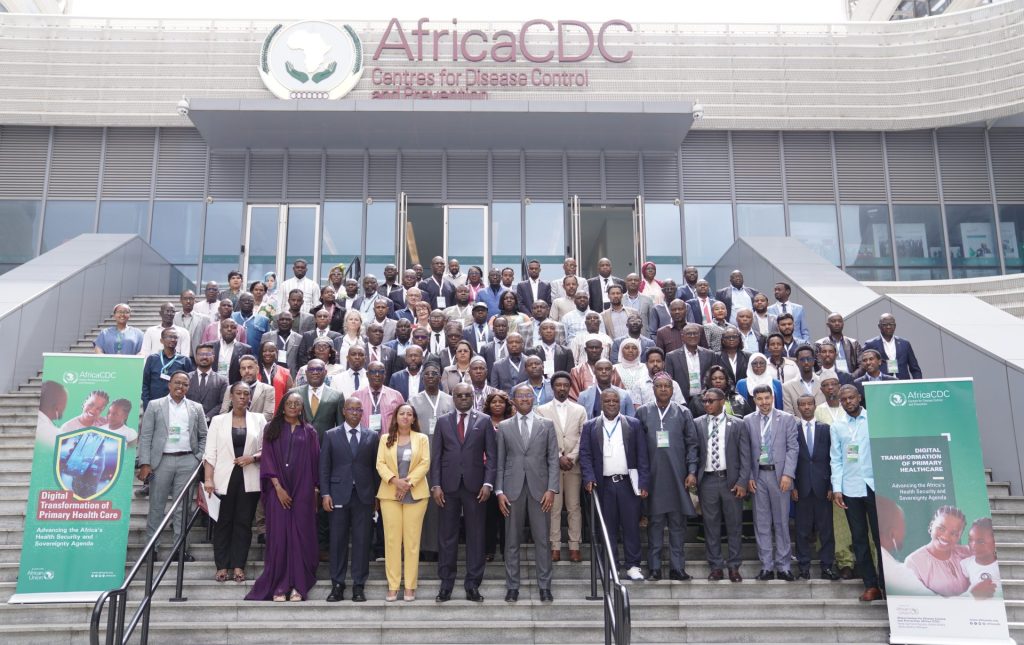
Addis Ababa, 2 April 2026 – The vision of a digitally enabled primary healthcare system across Africa has taken one step forward as African Union Member States, United Nations agencies, development partners and technical experts convened to validate the Africa Centres for Disease Control and Prevention (Africa CDC) Primary Health Care Digitalisation Framework.
The Framework provides a continental roadmap for digitalising primary health care – the point where more than 80 percent of health interactions occur in Africa. It establishes the foundation for interoperable systems that connect communities, health workers, facilities and policymakers, improving service delivery and enabling real‑time decision‑making during routine care and health emergencies.
Anchored in the Africa Health Security and Sovereignty (AHSS) Agenda, the Framework positions digital transformation as a core pillar of Africa’s health security architecture. Africa CDC aims to digitalise 90 percent of primary health care systems by 2035, strengthening the continent’s ability to generate and govern its own health intelligence.
Opening the workshop, H.E. Dr Jean Kaseya, Director General of Africa CDC, underscored the role of digitalisation: “Digital transformation is not a luxury; it is the backbone of resilient health systems… one that allows our countries to detect outbreaks earlier, allocate resources more effectively, and ensure that every African life is visible within our health systems.”
He also highlighted the 2026 AU Summit’s appointment of Ethiopia’s Prime Minister, H.E. Abiy Ahmed, as the AU Champion for Digital Transformation and Artificial Intelligence, signalling political commitment at the highest level.
In her keynote, H.E. Dr Mekdes Daba, Ethiopia’s Minister of Health, stressed that digitalisation strengthens systems and empowers health workers:
“When implemented effectively, digital health systems expand access, improve efficiency, and help health systems respond more effectively to the needs of our populations,” she said.
Development partners also expressed strong support. For example, Sean Blaschke of UNICEF noted that the Framework helps countries move beyond fragmented digital pilots. Dr Onyango Adelheid from WHO-AFRO emphasised its importance for maternal and child health, immunisation and disease prevention.
The Framework introduces a Continental Health Intelligence Architecture, including a Central Data Repository powered by the OKAPI AI layer, and promotes interoperable digital public infrastructure such as unique health identifiers, digital registries and national data platforms.
Following the validation, Africa CDC will support Member States in developing costed national implementation roadmaps and financing plans. Partners were encouraged to align investments to ensure coordinated, country‑led digital transformation.
###
About Africa CDC
The Africa Centres for Disease Control and Prevention (Africa CDC) is the public health agency of the African Union. As an autonomous institution, Africa CDC supports AU Member States to strengthen health systems, improve disease surveillance, and enhance emergency preparedness and response. For more information, visit: http://www.africacdc.org and follow Africa CDC on LinkedIn, X, Facebook, and YouTube.
Media Contact
Margaret Edwin | Director of Communication and Public Information EdwinM@africacdc.org