Zanzibar, United Republic of Tanzania | 30 March 2026 — Nearly 2 million Africans die prematurely each year from complications related to hypertension and diabetes alone, and only an estimated10–20% of those living with these conditions receive regular care. In response Africa CDC has launched a major continental initiative to strengthen surveillance, improve integrated care, and transform the continent’s response to non-communicable diseases.
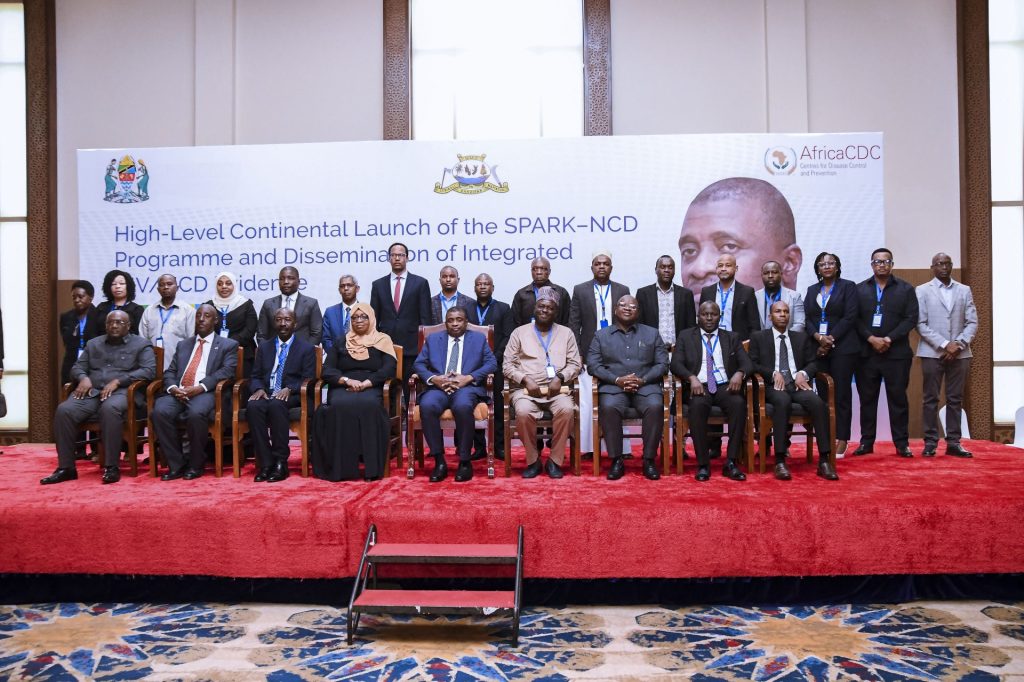
The SPARK–NCD Programme (Strengthening Public Health Surveillance and Resilient Knowledge for Non-Communicable Diseases in Africa)was officially launched in Zanzibar in collaboration with African Union Member States and partners. It is Africa CDC’s flagship initiative to strengthen surveillance systems, enhance NCD data generation, build workforce capacity, and advance integrated, people-centred care across Africa.
Delivered through existing national platforms, including the Field Epidemiology Training Programme (FETP) Frontline platform, the initiative is designed to embed NCD intelligence within health systems that countries already own and operate, building capacity from within rather than creating parallel structures.
Officiating the launch, H.E. Hemed Suleiman Abdulla, Second Vice President of Zanzibar, speaking on behalf of H.E. Dr Hussein Ali Mwinyi, President of Zanzibar and Chairman of the Revolutionary Council, described the initiative as a major turning point for Africa’s health systems: “This is not just another programme. It is potentially the most significant transformation in health systems since the establishment of vertical HIV programmes over three decades ago.”
He also stressed the urgency of implementation, noting that the question before Africa is no longer whether integration should happen, but how effectively it can be achieved and the speed at which this can occur.
Africa is undergoing a profound epidemiological transition. As life expectancy rises and health systems continue to improve, non-communicable diseases have emerged as a defining public health challenge. Cardiovascular diseases, diabetes, cancers, chronic respiratory diseases, and mental health conditions are rising rapidly across every region of the continent, increasingly affecting people in the prime of their lives and driving premature mortality, disability, household impoverishment, and sustained pressure on health systems and economies.
Despite this growing burden, surveillance systems for NCDs remain fragmented and under-resourced in many countries, limiting governments’ ability to detect, monitor, and respond effectively. In too many settings, people live for years with high blood pressure or diabetes without diagnosis, and many others are diagnosed but not retained in care.
The SPARK–NCD initiative aims to address this gap by strengthening surveillance systems for NCDs, injuries, and mental health; building a skilled public health workforce; embedding NCD intelligence within national systems to inform decision-making and improve outcomes; and supporting countries to institutionalise integrated care at scale.
Dr Raji Tajudeen, Acting Deputy Director General of Africa CDC, described SPARK–NCD as a strategic investment in Africa’s public health systems, “SPARK–NCD is a strategic investment in public health architecture. It will help countries move from fragmented data to actionable intelligence, and from isolated programmes to integrated, people-centred care.”
He added that the programme reflects a clear recognition that Africa can no longer afford to treat NCDs as a silent crisis at the margins of public health planning, and that surveillance, prevention, and integrated chronic disease care must become central pillars of Africa’s health security and sovereignty.
The launch followed a high-level policy dialogue drawing on more than a decade of research from Tanzania and Uganda, which demonstrated that integrating HIV and NCD services is safe, equitable, cost-effective, and improves access without compromising HIV outcomes. The evidence also showed that community-based models can achieve comparable clinical outcomes while reducing costs and helping decongest health facilities.
These findings point to a major opportunity for Africa to build on the success of its HIV response. For too long, HIV and NCD programmes have operated in silos, with limited sharing of resources, workforce models, and implementation lessons. The evidence now shows that bringing HIV and NCD care under one roof — and delivering more services closer to communities — is both feasible and effective.
The SPARK–NCD initiative aligns with the African Union Common Position on Multisectoral Engagement, Coordination and Action for NCDs, injuries, and mental health, reinforcing a whole-of-government and whole-of-society approach to prevention, surveillance, and care.
As Africa undergoes a major epidemiological transition, the launch of SPARK–NCD signals a decisive step toward more resilient, data-driven, and people-centred health systems, and a growing continental determination to confront the rising burden of chronic disease with urgency, scale, and African leadership.
###
About Africa CDC
The Africa Centres for Disease Control and Prevention (Africa CDC) is the public health agency of the African Union. As an autonomous institution, Africa CDC supports AU Member States to strengthen health systems, improve disease surveillance, and enhance emergency preparedness and response. For more information, visit: http://www.africacdc.org and follow Africa CDC on LinkedIn, X, Facebook, and YouTube.
Media Contact Margaret Edwin
Director of Communication and Public Information EdwinM@africacdc.org